With the explosive growth of the smart ring market globally, these ultra-lightweight, unobtrusive wearable devices are rapidly becoming the new favorites in health monitoring. However, between extreme physical space constraints and high-frequency pulse sampling (such as PPG, ECG, and blood pressure trend monitoring), smart ring battery life and capacity fade are emerging as the core technical barriers in brand competition.
For R&D engineers, squeezing every milliampere-hour (mAh) out of a micrometer-scale space while ensuring the smart ring maintains an excellent cycle life after years of use is a demanding electrochemical miniaturization battle.
Space & pulse: the smart ring battery dilemma
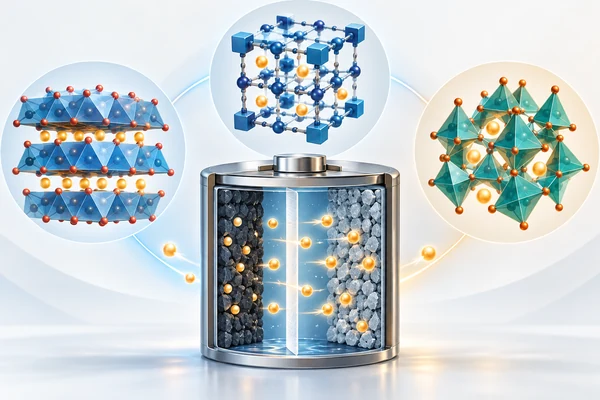
The internal space of a smart ring is meticulously calculated in cubic millimeters (mm3). Currently, mainstream smart rings typically utilize customized curved lithium-polymer (Li-Po) batteries or micro all-solid-state batteries, with nominal capacities ranging from a tiny 15 mAh to 25 mAh.
Supporting continuous operation for 4 to 7 days with such a minuscule capacity requires software algorithms and hardware low-power designs to be pushed to their absolute limits. From an electrochemical and hardware engineering perspective, this presents two core technical bottlenecks:
The Ultimate Challenge of Volumetric Energy Density (Wh/L): Since the smart ring's structural casing, protection circuit modules (PCM), and packaging materials occupy significant space, the volume fraction of active materials inside the battery is severely compressed.
High-Rate Pulse Discharge Mechanism: Smart rings do not consume power at a constant rate. During LED sensor sampling or BLE (Bluetooth Low Energy) data synchronization, transient pulse currents of several to tens of milliamperes are generated. For a 20 mAh battery, a 20 mA pulse translates to a transient discharge rate of 1C or even higher, which places extremely high demands on the smart ring battery's Direct Current Internal Resistance (DCR).
Three key metrics for smart ring battery life
To evaluate the quality of a smart ring battery, engineers and R&D teams must focus on the following three critical electrochemical performance indicators:
A. coulombic efficiency (CE) and smart ring cycle life
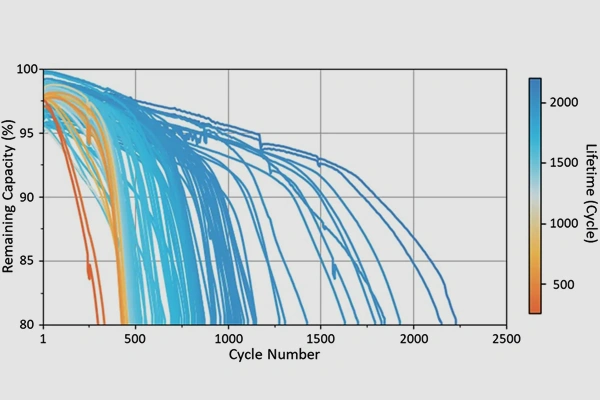
The Coulombic Efficiency (η = Qdischarge/ Qcharge) during charge-discharge cycles is the decisive factor for long-term lifespan. In micro-batteries, due to the extremely small volume of electrolyte, lithium-ion consumption caused by side reactions (such as continuous SEI layer growth) has a much more sensitive impact on capacity fade than in smartphone or EV batteries. An excellent smart ring battery should maintain over 80% capacity retention after 500 charge-discharge cycles.
B. DC internal resistance (DCR) and smart ring IR drop
Micro-batteries generally exhibit high internal resistance, often ranging from hundreds of milliohms to several ohms. When the aforementioned Bluetooth or sensor pulse discharges occur, an excessive voltage drop (IR Drop) caused by internal resistance can prematurely trigger the system's under-voltage protection (such as UVLO - Under-Voltage Lockout), leading to premature shutdown or abnormal smart ring system reset. Accurately testing the DCR evolution under different SoC (State of Charge) levels is fundamental for predicting smart ring battery life and optimizing power management strategies.
C. Micro-Current Self-Discharge rate and smart ring shelf life
Because smart rings may sit in charging cases for extended periods or enter deep sleep modes when not worn, the micro-current self-discharge (typically required to be less than a few microamperes) directly determines shelf life and standby user experience. During the R&D phase, high-precision measurement techniques must be used to accurately capture this self-discharge current.
Smart ring battery testing: limitations of legacy equipment
For R&D teams, conventional battery testers often fall short when testing smart ring batteries. The root cause is the extremely small test currents involved, which typically range from microamperes ($\mu\text{A}$) to milliamperes (mA).
If the current resolution and accuracy of the test channels are insufficient, minor deviations in charge-discharge precision will accumulate over long-term cycling, leading to distorted Coulombic Efficiency (CE) calculations and failing to evaluate smart ring battery life accurately. High-standard testing for smart ring batteries must meet two rigid criteria:
Multi-range Auto-switching: During the end of constant-voltage (CV) charging, the current decays to hundreds of microamperes or lower. The testing instrument must automatically switch to a microampere range to ensure the sampling accuracy of the cut-off current.
Microsecond-level High-frequency Sampling: To capture the dynamic voltage drop at the instant of pulse discharge, the tester must feature an ultra-high sampling rate and high-precision analog-to-digital (ADC) conversion.
Scaled verification: NEWARE 4 series testing system
In the R&D and testing workflow of smart ring batteries, apart from initial fine electrochemical analysis, large-scale cycle life verification and consistency screening are equally indispensable steps. Smart ring batteries often require hundreds of cycles or even longer testing periods, which objectively places practical demands on the channel density, long-term operational stability, and overall deployment cost of the testing equipment.
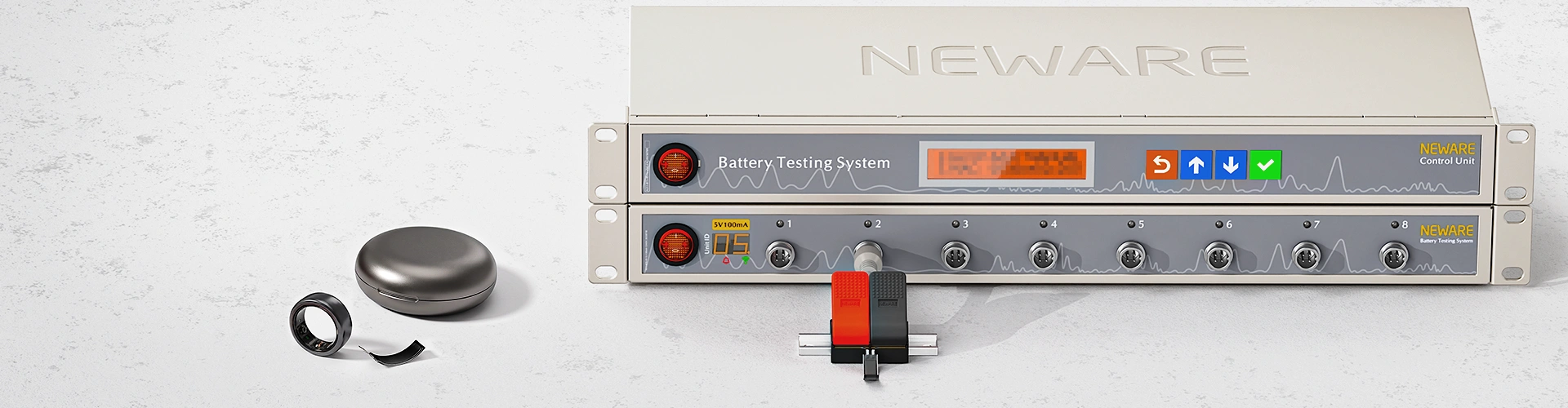
NEWARE 4 Series Battery Testing System is a classic choice designed specifically to meet these high-concurrency, long-cycle testing needs.
As a market-proven classic testing system in the industry, the Neware 4 Series, with its high operational stability, exceptional cost-effectiveness, and high-density channel design, can well assist R&D and testing teams in conducting large-scale life testing and long-cycle verification for smart ring batteries. Supporting multi-channel simultaneous operations, it is dedicated to providing consistent and reliable data logging for testing personnel over months of continuous cycling, helping various R&D teams optimize hardware investment costs and smoothly advance their testing processes while meeting fundamental testing needs.