Start with a consistent classification
The most useful way to group common sodium-ion batteries is by cathode material: layered oxides, Prussian blue analogues, and polyanion compounds. Their crystal frameworks differ, as do their structural responses to sodium insertion and extraction, operating voltages, and material densities. [1][2][4] A cathode name, however, does not specify a complete cell. Hard carbon describes a common anode; aqueous and nonaqueous describe electrolyte systems; cylindrical and pouch describe cell formats. These are separate classification axes.
Before comparing performance, establish whether a result comes from a material half-cell or a full cell with a hard-carbon anode. The former often reports capacity per mass of cathode active material. The latter is affected by first-cycle sodium loss, electrode balancing, and the mass of inactive cell components. Treating both figures as directly comparable cell energy densities can lead to a false conclusion.
Layered oxides: capacity potential with structural trade-offs
Layered oxides are often written as NaXTMO2, where TM denotes a transition metal. Sodium resides between oxide slabs and moves into and out of the interlayer space during cycling. The common P2 and O3 labels describe sodium in prismatic and octahedral sites, respectively, as well as the oxygen-layer stacking sequence; they do not denote two fixed elemental formulations. Figure 1 shows the distinction. [1] O3 materials often start with more sodium, which can provide inventory for a full cell. P2 structures offer relatively open sodium migration paths, but their lower initial sodium content can constrain some full-cell designs. The outcome still depends on composition and cutoff voltage.
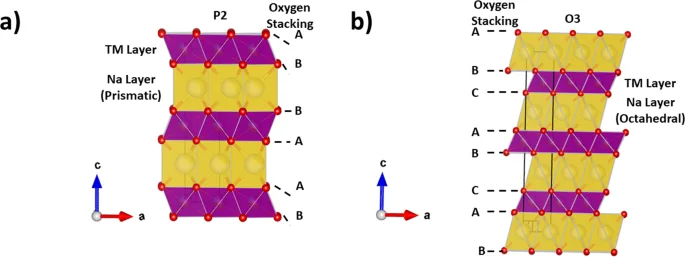
Figure 1. Sodium sites and oxygen-layer stacking in P2 and O3 layered oxides.
A key limitation is that deep desodiation can trigger slab gliding and phase transitions, adding stress, changing interfaces, and contributing to capacity loss. Sensitivity to air or moisture can also complicate processing. The cycling behavior of one optimized formulation should not be generalized to every layered oxide. Tests should report cathode composition, upper cutoff voltage, temperature, and rate, and examine charge–discharge profiles, capacity retention, and impedance together. [1]
Prussian blue analogues: open frameworks with defects to control
Prussian blue analogues (PBAs) form open three-dimensional frameworks through metal–cyanide–metal linkages. Sodium can occupy sites inside the framework. The cyanide groups here are coordinated structural units; a material name alone does not establish the risk profile of a finished cell. Open pathways have drawn interest for fast-charging and storage applications. Figure 2 shows the framework and representative material characterization. [2][3]
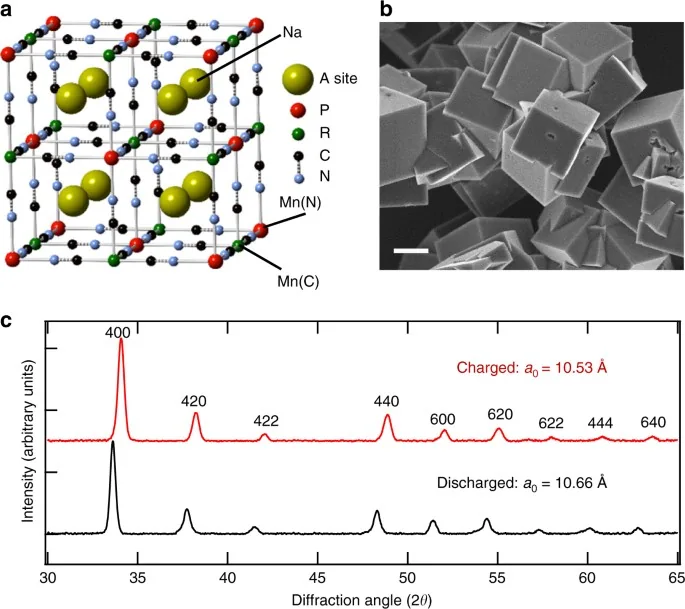
Figure 2. Framework, particle morphology, and diffraction patterns of a Prussian blue analogue before and after cycling.
Vacancies, crystal water, and local coordination established during synthesis influence the available sodium sites and cycling stability. Recent work also identifies coordination-bond stability and utilization of redox-active sites as important factors. Capacity loss therefore cannot automatically be blamed on water or vacancies alone. When comparing PBA-based cells, check water and sodium content, material preparation, electrolyte, and cycling cutoffs. [2]
Polyanion compounds: stable frameworks, with conductivity and cost penalties
Polyanion cathodes include phosphates, fluorophosphates, and sulfates. Structural units such as PO4 often form robust frameworks that can support cycling and thermal stability, while the choice of anion group influences transition-metal redox potential. The NaVPO4F shown in Figure 3 is one fluorophosphate research example with sodium migration paths. Its properties should not be treated as specifications for the whole family. [4]
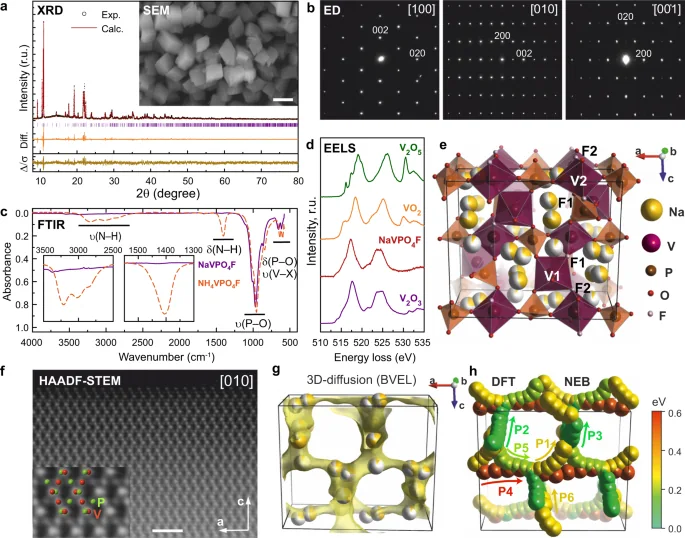
Figure 3. Structural characterization and sodium migration pathways of the fluorophosphate NaVPO4F.
This family does not automatically combine low cost with high energy. Some compositions contain vanadium, so raw-material and synthesis costs need separate assessment. Some compounds have limited electronic conductivity and require carbon coating or particle engineering, adding inactive mass and process steps. [4] For a practical decision, consider the cathode voltage profile, electrode density, carbon content, and full-cell rate performance together rather than comparing cathode-only capacity in mAh g-1.
How to compare complete cells
First, align the test level and conditions: temperature, charge and discharge rates, voltage window, and the endpoint used for capacity retention. Reports should state electrode balancing, first-cycle efficiency, active-material loading, cell format, any presodiation, and the mass basis for energy density. Then match the measurements to the project. For size and energy, check electrode density and complete-cell energy. For power and lifetime, compare polarization, temperature rise, and capacity fade under equivalent conditions. For cost, include feedstocks, manufacturing yield, and system design.
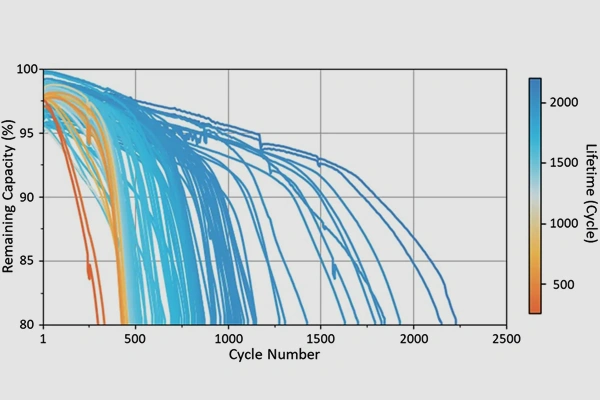
A battery test system can record capacity, energy, rate response, and cycling curves under a common protocol; temperature control helps isolate thermal effects. When unusual fading appears, impedance measurements or materials characterization can help investigate it. One charge–discharge curve may reveal a changing plateau, but cannot by itself prove a phase transition, rising defect concentration, or interface failure.
Conclusion
Layered oxides, Prussian blue analogues, and polyanion compounds provide a useful first classification of common sodium-ion batteries. Layered oxides call for attention to sodium inventory and structural evolution; PBAs to framework defects and coordination stability; and polyanion materials to their framework benefits alongside conductivity and cost. Final selection still depends on complete-cell results measured under consistent conditions.
References
[1] Maughan PA, Naden AB, Irvine JTS, et al. Manipulating O3/P2 phase ratio in bi-phasic sodium layered oxides via ionic radius control. Communications Materials, 2023, 4: 6. DOI: 10.1038/s43246-023-00337-8.
[2] Wang Y, Yan J, Xie B, et al. Tuning cyanide coordination electronic structure enables stable Prussian blue analogues for sodium-ion batteries. Nature Communications, 2025, 16: 10083. DOI: 10.1038/s41467-025-65062-x.
[3] Firouzi A, Qiao R, Motallebi S, et al. Monovalent manganese based anodes and co-solvent electrolyte for stable low-cost high-rate sodium-ion batteries. Nature Communications, 2018, 9: 861. DOI: 10.1038/s41467-018-03257-1.
[4] Shraer SD, Luchinin ND, Trussov IA, et al. Development of vanadium-based polyanion positive electrode active materials for high-voltage sodium-based batteries. Nature Communications, 2022, 13: 4097. DOI: 10.1038/s41467-022-31768-5.