Cell life can vary widely within a single dataset
A battery-life project often begins with a tidy test plan: identical cell model, identical equipment, and a fixed cycling procedure. The completed dataset may be anything but tidy. Some cells reach the end-of-life threshold after a few hundred cycles, while others continue for more than two thousand. Manufacturing variation matters, but charging policy and operating conditions can also push nominally similar cells onto different degradation paths.
Yao and co-workers illustrated this spread using a dataset of 124 lithium iron phosphate (LFP)/graphite cells. Cycle life ranged from roughly 300 to 2,300 cycles.[4] The point is not that one curve represents an intrinsically better cell. It is that small differences early in life can precede very different long-term outcomes.
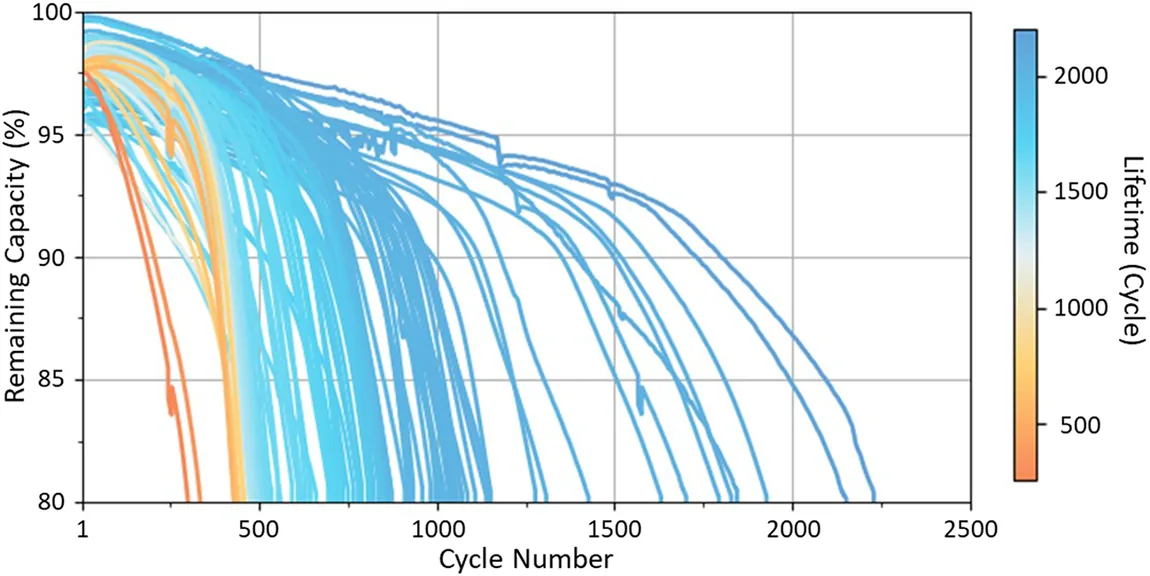
Figure 1. Capacity-fade trajectories and cycle-life variation within one battery dataset.
This is why machine learning entered battery prognostics. Severson and co-workers showed that subtle changes in early discharge curves can contain information associated with eventual cycle life.[1] For a development team, early prediction could shorten material screening and charging-protocol evaluation. The difficult step is moving from a relationship found in one dataset to a reliable prediction for the next product.
Why a model can succeed in the laboratory and fail in a product
Consider a model trained on cells cycled at 25 °C under fixed current profiles. It may separate long-lived and short-lived cells in that program very well. The deployed product, however, may charge in winter, operate within a partial state-of-charge window, and use cells from a different production batch. To the model, this is not a harder example of the same task; it is a change in the task itself.
Machine learning is strongest when a new sample resembles the training data. This is interpolation. Product deployment often asks the model to handle a temperature, C-rate, batch, or chemistry that was absent during training. This is extrapolation. Many reported accuracy values describe the first case but are interpreted as evidence for the second.
A model may also learn the test protocol instead of degradation. If high-rate cells in a dataset tend to fail early, charge time, temperature rise, and voltage shape all become convenient markers of short life. The model can exploit those markers without learning whether the underlying cause was lithium plating, interfacial side reactions, or another process. Once the charging protocol changes, the shortcut may disappear.
What physics-informed machine learning adds
Physics-informed machine learning (PIML) is not one particular neural-network architecture. It is a modeling strategy: fit the observations while requiring predictions to remain consistent with selected battery knowledge. Capacity, lithium inventory, and electrode states should remain within plausible bounds; temperature should not be unrelated to degradation rate; and behavior already captured by a physical model need not be relearned entirely from data.
Navidi and co-workers compared four ways to connect battery physics and machine learning, including physics-informed neural networks, simulation-based data augmentation, and multi-fidelity approaches that learn the difference between a physical model and measured cells.[2] Their common purpose is not to build a larger network. It is to use limited aging data with stronger structure.
PIML is best viewed as a guardrail. It can reject some physically unreasonable solutions, but it cannot make an incomplete mechanism complete. If the physical model omits low-temperature lithium plating, particle fracture, or path-dependent aging, generating more synthetic data will reproduce the same omission. Physics may improve the chance of extrapolation; it does not prove that extrapolation is valid.
How early-cycle data become a life prediction
A typical workflow extracts capacity, voltage-curve, resistance, and temperature features from the first tens or hundreds of cycles. The features are compressed or selected, then related to the final cycle life through a regression model. The framework reported by Yao and co-workers provides a clear example of this sequence.[4]
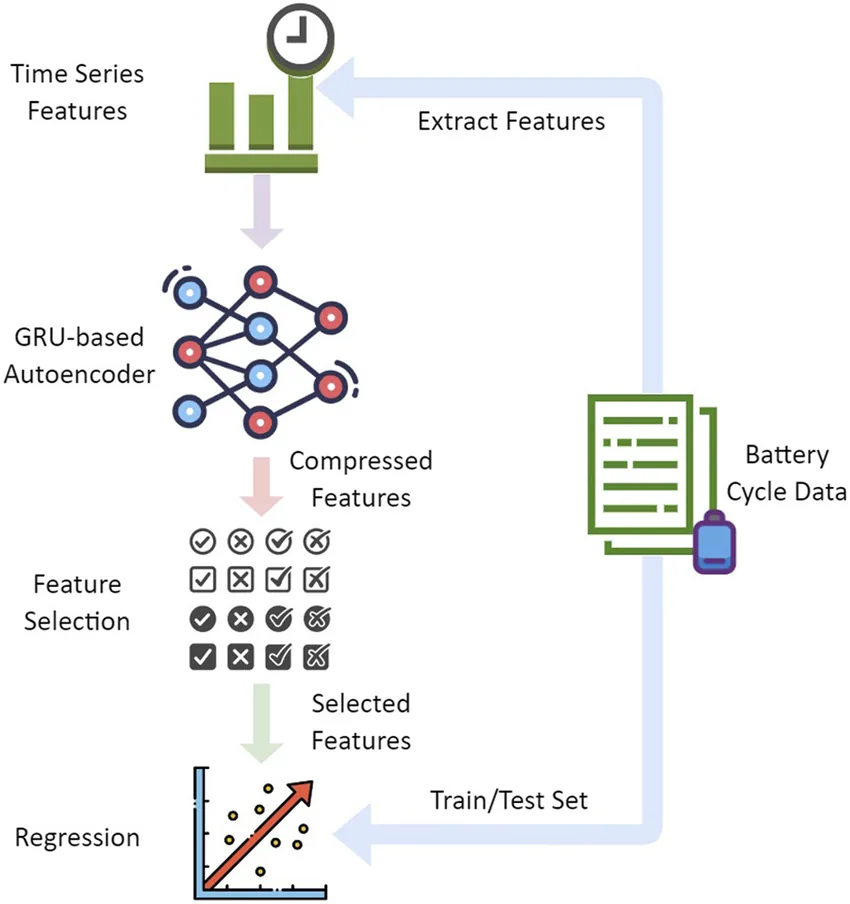
Figure 2. A representative workflow for predicting battery life from early-cycle features.
The train/test split in this workflow is more consequential than it looks. One cell produces hundreds of correlated cycle records. If those records are divided at random, neighboring cycles from the same cell can appear in both training and test sets. The score may be excellent because the model has already seen that cell. It does not show that the model can predict a new cell. At minimum, all cycles from one cell must stay in one split. To test extrapolation, an entire temperature, protocol, or production batch should be held out.
Physics has an operating envelope too
The phrase “physically interpretable” deserves a follow-up question: which physics is included, and where is it valid? High-temperature cycling and low-temperature fast charging can both shorten life, but they need not share the same dominant mechanism. A degradation equation calibrated at high temperature may not describe lithium plating during cold charging.
Internal degradation states may also be non-unique. Capacity loss can arise from loss of lithium inventory or loss of active material at either electrode, and different combinations can produce similar full-cell voltage curves. If a model reports a 5% loss of lithium inventory, that number is more credible when it is checked against low-rate voltage data, incremental-capacity analysis, impedance, reference-electrode measurements, or post-mortem evidence. A latent variable generated only by the model cannot validate its own physical meaning.
Recent work treats changes in temperature, C-rate, and chemistry as domain shifts and develops models specifically for performance across domains.[3] This is closer to deployment than a random split of mixed conditions. It still does not remove the need to validate the method on the company’s own cells and operating envelope.
A validation plan that resembles deployment
A practical validation campaign can proceed in three rounds. First, hold out complete cells so that no cycle from a test cell appears during training. Second, hold out a full operating condition, such as 10 °C charging or a particular state-of-charge window. Third, use an independent manufacturing batch and, where possible, data from another tester or laboratory. Each round answers a different question: new individual, new condition, and new data source.
The dataset, preprocessing, and evaluation metrics should be frozen before the final test is opened. Revising features, outlier rules, or the end-of-life threshold after seeing the result turns the test set into another training set. A prospective blind test is stronger: the model predicts cells that are still cycling, the predictions are timestamped and sealed, and the results are opened only after the cells reach the predefined endpoint.
Average error alone is not enough. Reports should state how early the prediction was made, how far into the future it extended, whether it crossed a capacity knee, and how the worst temperature or C-rate group performed. A good average can hide failure in the operating condition that matters most.
A life estimate needs a credible uncertainty range
Engineering decisions rarely need only “1,500 cycles.” Warranty planning, second-life screening, and maintenance scheduling need a range. Cell-to-cell variability cannot be eliminated, and the model becomes less certain when the target condition is poorly represented in training. Both effects should be visible in the prediction interval.
If a model claims a 90% prediction interval, independent tests should check whether about nine out of ten true lifetimes fall inside it. A narrow interval that often misses the outcome is overconfident. An interval so wide that it cannot guide a decision indicates that more evidence is needed. For a clearly unfamiliar cell or duty cycle, a mature system should be able to request additional testing instead of always returning a precise number.
What data a company must preserve
A useful aging dataset contains more than cycle number and capacity. Cell ID, manufacturing batch, chemistry, nominal capacity, channel and range, calibration status, chamber position, cell-surface temperature, procedure version, cutoff rules, state-of-charge window, rest time, and logging conditions can all affect how a model reads a curve. Power interruptions, chamber deviations, and fixture changes should remain traceable rather than silently disappearing during cleaning.
Different aging conditions also need a common reference. Periodic reference performance tests can measure capacity, low-rate voltage response, and direct-current resistance under fixed conditions. Electrochemical impedance spectroscopy (EIS), temperature, or pressure measurements can be added when the degradation question requires them. The aging protocol creates different histories; the reference test compares those histories on the same scale.
The test matrix does not need every possible combination, but it must cover the degradation paths that the product is likely to encounter. A large room-temperature full-cycle dataset does not replace evidence from cold fast charging or high-state-of-charge storage. PIML can improve data efficiency. It cannot turn an unperformed critical experiment into an observed one.
How the test platform fits into the project
A lifetime model needs comparable data, not simply more data. Aging steps, cutoff conditions, rest periods, logging rules, and reference-test intervals should be fixed before the campaign begins. If a change is necessary, the procedure version and effective date must be retained; otherwise, the model may interpret a procedural change as cell degradation.
Multi-channel programs should link cell ID and manufacturing batch to test channel, chamber position, and recorded anomalies. Current, voltage, capacity, and auxiliary temperature signals need a common time base and sample identity. Chamber setpoint should not automatically be treated as cell-surface temperature, and a single-frequency AC resistance measurement should not be presented as broadband EIS. Additional signals should be selected to test a degradation hypothesis, not merely to increase feature count.
NEWARE battery test systems can execute version-controlled cycling and reference procedures and export main-channel and configured auxiliary-channel data. Once the raw data enter the analytics environment, cleaning rules, feature calculations, dataset splits, and model versions still need separate control so that a prediction can be traced back to the corresponding cell, procedure, and source curve. Available functions and synchronization capabilities should be confirmed for the selected hardware and software versions.
Conclusion
Physics-informed machine learning offers a useful route to battery-life prediction. It can bring electrochemical knowledge into a data model, reduce implausible outputs, and use simulation and limited experiments more effectively. It does not remove the uncertainty created by material variation, changing duty cycles, and missing degradation pathways.
Before trusting a lifetime model, a company should establish what cells the model has seen, which conditions were held out during testing, and how uncertainty changes outside the training range. Claims about internal degradation states should have independent evidence. With that chain of evidence, PIML can move from an attractive laboratory result toward a tool for screening, warranty analysis, and operational decisions.
References
[1] Severson, K. A.; Attia, P. M.; Jin, N.; et al. Data-driven prediction of battery cycle life before capacity degradation. Nature Energy, 2019, 4: 383–391. https://doi.org/10.1038/s41560-019-0356-8
[2] Navidi, S.; Thelen, A.; Li, T.; Hu, C. Physics-informed machine learning for battery degradation diagnostics: A comparison of state-of-the-art methods. Energy Storage Materials, 2024, 68: 103343. https://doi.org/10.1016/j.ensm.2024.103343
[3] Tan, R.; Lu, X.; Cheng, M.; et al. Forecasting battery degradation trajectory under domain shift with domain generalization. Energy Storage Materials, 2024, 72: 103725. https://doi.org/10.1016/j.ensm.2024.103725
[4] Yao, J.; Powell, K.; Gao, T. A two-stage deep learning framework for early-stage lifetime prediction for lithium-ion batteries with consideration of features from multiple cycles. Frontiers in Energy Research, 2022, 10: 1059126. https://doi.org/10.3389/fenrg.2022.1059126