Why fixed test steps remain essential, but are not always flexible enough
In a conventional charge-discharge test, engineers predefine constant-current, constant-voltage, rest, pulse, temperature, and cycle-termination conditions. The battery tester then executes this workflow as specified. This approach supports reproducibility, comparison, and traceability, especially in regulatory, standards-based, and quality-control applications. AI therefore does not make fixed test steps obsolete.
The challenge is that battery performance depends simultaneously on chemistry, manufacturing batch, C-rate, temperature, state of charge (SOC), and operating history. Testing every combination causes the experimental space to expand rapidly, while a full cycle-life test may continue for months or longer. A fixed protocol can answer, 'How does this cell perform under predefined conditions?' It is less effective at answering, during the experiment, 'Which test should be run next to gain the most useful information?'
What is AI-driven intelligent closed-loop testing?
Intelligent closed-loop testing is more than running an algorithm after a test has ended. It creates a continuous feedback path between data analysis and test execution. A typical workflow includes the following steps: the battery tester records voltage, current, capacity, temperature, and time-series data; a model identifies the current state and estimates future changes; a decision module selects the next parameter set according to an objective function and safety boundaries; and the test system executes the updated strategy before returning new results to the model.
The defining feature of a closed loop is not automation alone. Each adjustment should have interpretable inputs, a clearly defined objective, and auditable boundaries. AI may select a C-rate or cutoff voltage from an approved set, but hardware protections, temperature limits, voltage limits, and emergency shutdown logic should remain independent.
Four stages of battery testing that AI is changing
1. Early prediction of battery cycle life
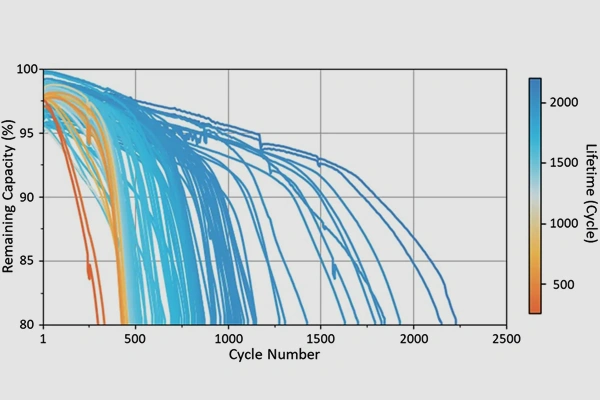
Cycle-life prediction is one of the most established applications of AI in battery testing. Severson et al. trained models using early-cycle data from 124 commercial lithium iron phosphate/graphite cells. The best model achieved a 9.1% test error when predicting final cycle life from the first 100 cycles. Using only the first five cycles to classify cells into two lifetime groups produced a 4.9% test error [1]. These results suggest that voltage curves may contain weak features associated with long-term aging before capacity degradation becomes readily visible.
These figures apply to a specific cell chemistry, fast-charging conditions, and dataset. They should not be treated as universal accuracy values for all batteries. The broader value lies in early screening: low-potential candidates can be eliminated sooner, leaving limited test channels available for samples that merit long-term validation.
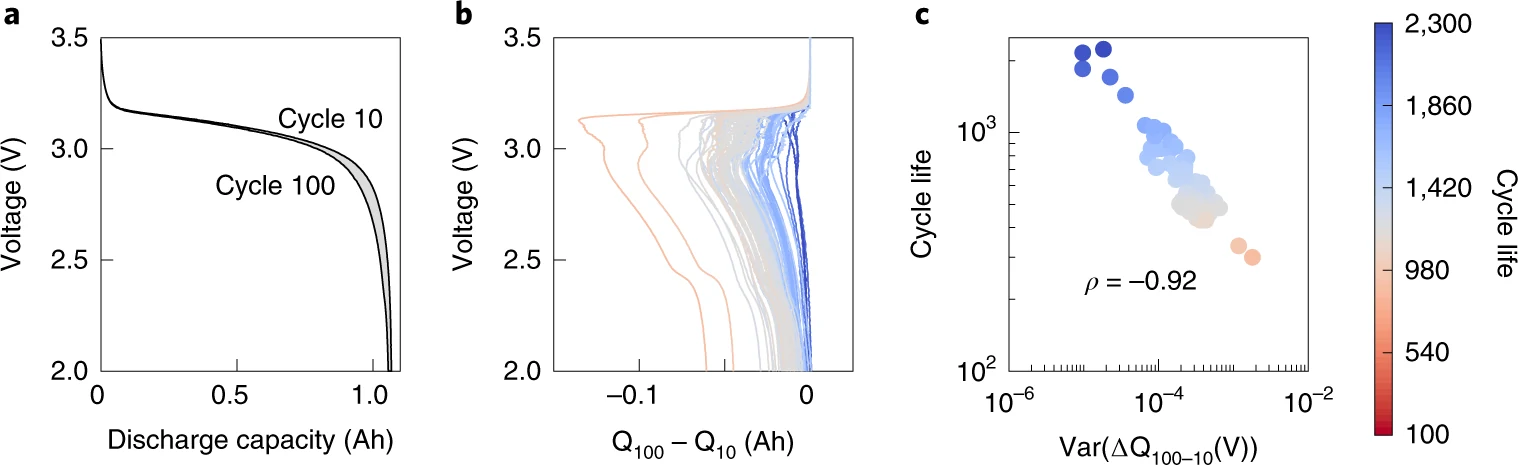
Figure 1. Early-cycle discharge-voltage features linked to battery cycle life. The figure compares discharge curves from cycles 10 and 100, the resulting ΔQ100−10(V) features across the cell dataset, and their correlation with final cycle life.
2. Estimating battery state of health
Machine learning can also extract features from charging voltage and current curves to estimate battery state of health (SOH) and provide confidence intervals. Roman et al. developed an SOH estimation pipeline using 179 cells cycled under different conditions. The best model achieved a root-mean-square error of 0.45% on cells subjected to a fast-charging protocol [2]. Compared with a single-point estimate, a confidence interval helps engineers understand how much trust to place in the model for a particular sample.
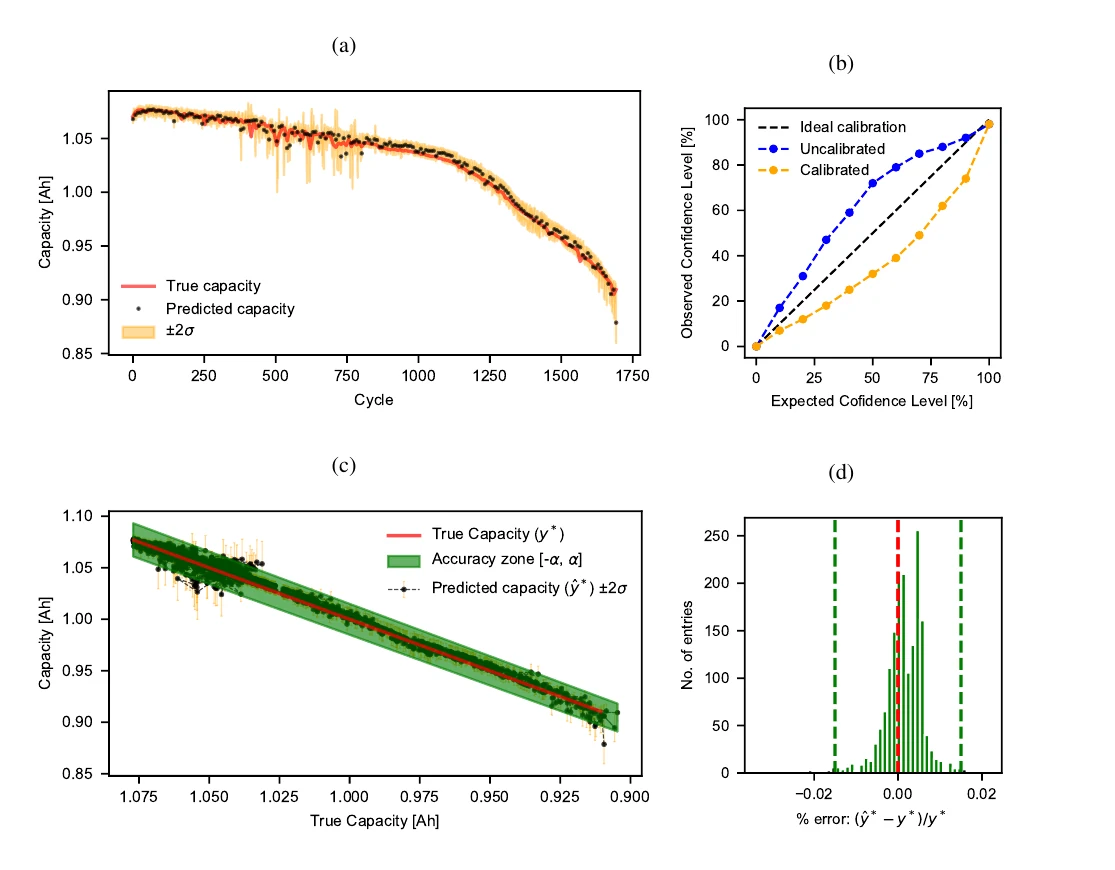
Figure 2. SOH prediction and uncertainty quantification for a fast-charged cell. The panels show predicted capacity, calibration behavior, actual-versus-predicted capacity, and the prediction-error distribution.
3. Optimizing test and charging protocols
When the parameter space is large, AI can reduce low-value experiments by balancing exploration and exploitation. Attia et al. combined early-life prediction with Bayesian optimization to identify long-life candidates among 224 ten-minute fast-charging protocols. The closed-loop experiment took 16 days. The study estimated that exhaustive search without early prediction would have required more than 500 days [3]. The method does not generate an optimal answer from nothing. Instead, results from one batch of experiments determine which combinations are most informative to test next.
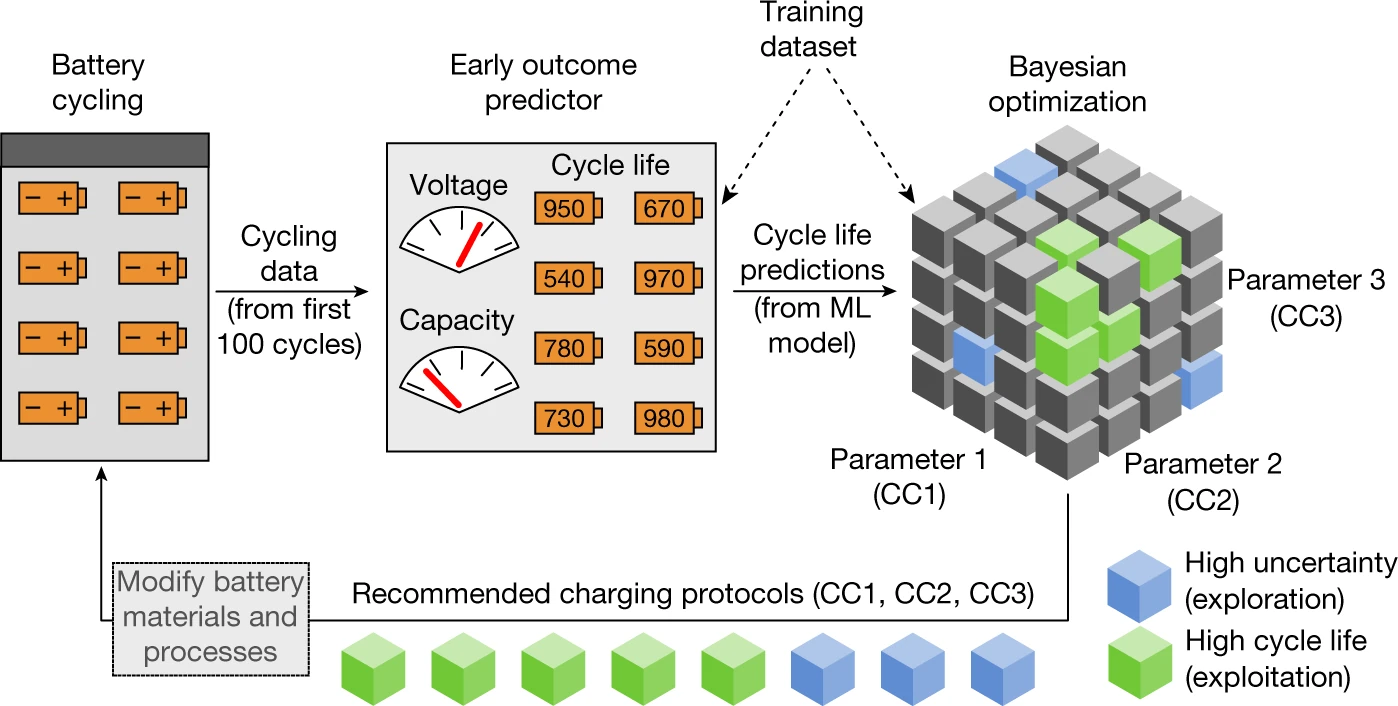
Figure 3. Closed-loop optimization of battery fast-charging protocols. Early cycle-life predictions feed a Bayesian optimization model that balances exploration and exploitation and recommends the next protocols to test.
4. Detecting battery states and adapting strategies in real time
A more advanced approach connects the model directly to the test equipment. A proof-of-concept study published in 2025 integrated machine-learning-based state detection and reinforcement learning with a solid-state lithium-metal battery test platform. Data were evaluated every three cycles, and subsequent charging strategies were adjusted according to whether the battery was in a stable, transitional, or decay state. At 80% SOH, the study reported that the intelligent strategy delivered 265% of the cycle life and 250% of the cumulative specific energy achieved by the fixed strategy [4].
The boundary of this result is equally important. The experiments used a specific solid-state cell architecture, low positive-electrode loading, charging rates of 15-20 C, and an environment of 55 degrees C. The work demonstrates the feasibility of a tester-AI-strategy feedback loop, but it does not show that the same performance gains will transfer directly to commercial lithium-ion batteries.
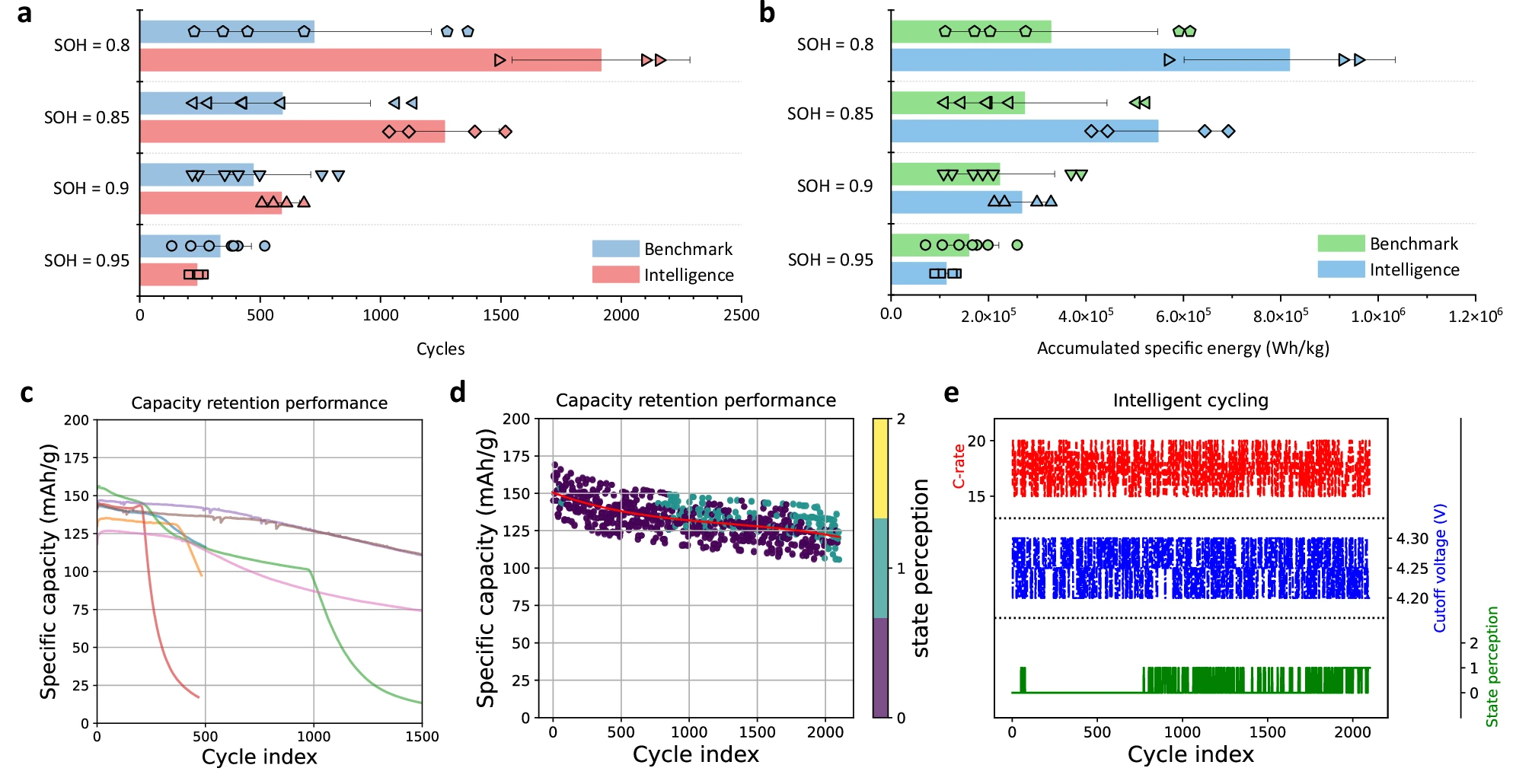
Figure 4. Performance of intelligent cycling compared with a fixed benchmark in solid-state lithium-metal batteries. The panels compare cycle life and cumulative specific energy at different SOH levels and show real-time state perception and adaptive charging actions.
High-quality battery data are the first requirement for AI deployment
An AI model does not inherently understand electrochemical mechanisms. It first learns statistical relationships between input data and target outcomes. If timestamps are inconsistent, temperature data are missing, range changes are not recorded, or different batches use different naming conventions and cutoff conditions, the model may learn spurious correlations. The Battery Data Genome initiative identifies fragmented and insufficiently standardized high-quality data as a major barrier to progress in battery data science. It proposes standardized data hubs with flexible sharing mechanisms [5].
A dataset intended for AI training and validation should record chemistry, cell specifications, batch, formation history, temperature, SOC window, C-rate, cutoff conditions, rest periods, sampling rules, equipment and channel information, calibration records, and software version. Curves without experimental context are often difficult to reuse across projects.
For laboratories and companies, the first step is usually not to train a complex model. It is to create a stable, consistent, and exportable data chain across charge-discharge tests, temperature-linked tests, pulse profiles, and multidimensional data management. Measurement accuracy, response speed, and metadata completeness determine what the model can learn.
What barriers separate data analysis from closed-loop control?
Can the model work across cells, temperatures, and operating conditions?
A model that performs well for one chemistry, manufacturing batch, and test regime may fail when transferred to another chemistry or temperature. Conditions outside the training set are out-of-distribution data and require separate validation. Accuracy from a single random train-test split cannot replace validation across batches, instruments, and time periods.
Are predictions physically meaningful and accompanied by uncertainty?
Engineering decisions require more than a cycle-life or SOH value. Engineers also need to know which curve features influenced the result, how wide the confidence interval is, and whether an anomaly originates in the cell or the measurement system. Physical constraints, conservation laws, and electrochemical diagnostics can help restrict implausible outputs.
Are safety protections independent of AI?
The AI decision layer should not override hardware protections for voltage, current, temperature, or power. A closed-loop system also needs permission management, strategy allowlists, exception fallback, communication-loss handling, and complete logs. In thermal-runaway or abuse testing, AI can support risk detection, but it cannot replace safety standards or isolation facilities.
Can equipment and software be integrated reliably?
A functional closed loop requires bidirectional interfaces. The system must read real-time data and equipment status, while also updating test steps within an authorized range. Interface protocols, time synchronization, control latency, test recovery, and version compatibility all affect stability. The 2025 real-time AI study implemented its data and control loop through bidirectional communication between a workstation and the battery test platform [4].
A phased approach to introducing AI battery testing
· Stage 1: Data digitization. Standardize naming, units, timestamps, test templates, and metadata fields, then establish a traceable data repository.
· Stage 2: Offline analytics. Begin with anomaly detection, curve clustering, batch comparison, and SOH estimation, allowing the model to serve as a second set of eyes.
· Stage 3: Decision support. Let the model recommend the next parameter set for engineer approval, while retaining control groups for human-selected and model-selected strategies.
· Stage 4: Controlled closed-loop operation. Automatically update test steps only within an explicit parameter allowlist and independent hardware protections, while continuously monitoring model drift.
· Stage 5: Scaled validation. Verify benefits across materials, batches, instruments, and environments, and determine whether saved channel time outweighs the cost of maintaining the system.
AI will not replace battery test engineers; it will change the division of work
The intelligent battery laboratory of the future will not hand test equipment to an opaque algorithm. Machines can handle repetitive screening, curve recognition, and candidate ranking. Engineers remain responsible for defining objectives, setting safety boundaries, judging anomalies, and validating mechanisms. Fixed test steps provide a trusted benchmark, while AI enables more efficient search and feedback. Together, they form an auditable testing system.
Conclusion
AI is expanding battery testing from execution and recording to perception, prediction, decision-making, and feedback. It may shorten candidate-screening time, improve channel utilization, and help researchers detect changes in life and state earlier. However, the performance ceiling of intelligent closed-loop testing is jointly determined by data quality, equipment interfaces, model generalization, and safety engineering. For most laboratories, the most reliable path is not to move directly to full automation. It is to establish a trustworthy data foundation first, then progress from offline analytics to decision support and ultimately to controlled closed-loop operation.
References
[1] Severson, K. A. et al. Data-driven prediction of battery cycle life before capacity degradation. Nature Energy 4, 383–391 (2019). https://doi.org/10.1038/s41560-019-0356-8
[2] Roman, D. et al. Machine learning pipeline for battery state-of-health estimation. Nature Machine Intelligence 3, 447–456 (2021). https://doi.org/10.1038/s42256-021-00312-3
[3] Attia, P. M. et al. Closed-loop optimization of fast-charging protocols for batteries with machine learning. Nature 578, 397–402 (2020). https://doi.org/10.1038/s41586-020-1994-5
[4] Wang, M. Y. et al. Real-time artificial intelligence for solid-state lithium metal batteries. Nature Communications 16, 11160 (2025). https://doi.org/10.1038/s41467-025-66079-y
[5] Ward, L. et al. Principles of the Battery Data Genome. Joule 6, 2253–2271 (2022). https://doi.org/10.1016/j.joule.2022.08.008