Q&A: Quick insights into battery capacity and life prediction
Q1: What is the relationship between battery capacity and life?
Battery capacity (mAh/Ah) is the amount of charge a battery can store, directly determining device runtime. Life is typically characterized by cycle life or the remaining capacity at retirement (generally 70–80% as the threshold). The two are closely linked: capacity fading to a certain extent means the end of life. Lithium iron phosphate (LFP) batteries are known for their ultra-long cycle life, reaching 3,000–5,000 cycles, with better thermal stability; ternary lithium (NCM/NCA) excel in high energy density but have cycle life typically between 500–2,000 cycles.
Q2: What is the approximate cycle life of mainstream batteries on the market?
LFP: 2,000–5,000 cycles, widely used in energy storage systems and electric buses. NCM/NCA: 500–2,000 cycles, widely used in EVs and consumer electronics. LCO: 300–500 cycles, mainly used in mobile phones and laptops.
Q3: How long does capacity testing and life testing usually take?
Capacity testing typically takes several hours to complete one full charge-discharge cycle. Life testing requires thousands to tens of thousands of cycles, spanning months or even years.
Q4: What life-prediction-related tests does NEWARE test equipment support?
Constant current/constant voltage charge-discharge cycles, cycle life at different C‑rates, DCIR tracking, dQ/dV differential capacity analysis, drive cycle simulation, pulse charge-discharge, EIS (electrochemical impedance spectroscopy), etc., helping to establish SOH (state of health) and RUL (remaining useful life) prediction models.
Q5: What level of accuracy has AI battery life prediction achieved so far?
Using a method combining Gaussian process regression (GPR) and incremental capacity analysis (ICA), only about 4 diagnostic measurements during the battery's lifetime achieve an NMAE mean error of 1.3% for SOH prediction and 5.3% for RUL prediction, significantly improving prediction accuracy.
Battery market panorama: Capacity and life challenges behind the expansion
The global lithium battery market is in an unprecedented period of expansion. In 2025, total global lithium battery demand grew by 29% year-on-year to 1.59 TWh, with grid‑scale energy storage batteries growing the fastest, up 50% year-on-year. This momentum is expected to strengthen further in 2026, with global energy storage battery demand projected to grow by approximately 64%, approaching 1,000 GWh.
Against this high‑growth backdrop, the importance of capacity and life prediction has become more prominent than ever. For EV users, how many years a battery will last and how far it can go on a single charge directly influence purchase decisions. For energy storage station operators, battery life determines IRR (internal rate of return), directly impacting project returns. For battery manufacturers, accurate capacity and life prediction can optimize product design and reduce warranty costs. For society as a whole, precise life prediction can postpone battery retirement, effectively lowering life‑cycle carbon emissions.
| Battery Type | Cycle Life (cycles) | Typical Energy Density | Thermal Stability | Application Scenarios |
Lithium Iron Phosphate (LFP) | 2,000-5,000 | 160-180 Wh/kg | Excellent | Energy storage, electric buses, home EVs |
Ternary Lithium (NCM/NCA) | 500-2,000 | 250-300 Wh/kg | Moderate | EVs, high‑rang econsumer electronics |
Lithium Cobalt Oxide (LCO) | 300-500 | 150-200 Wh/kg | Poor | Mobile phones, laptops |
Table 1 comparison of lifetime parameters of mainstream lithium-ion battery types
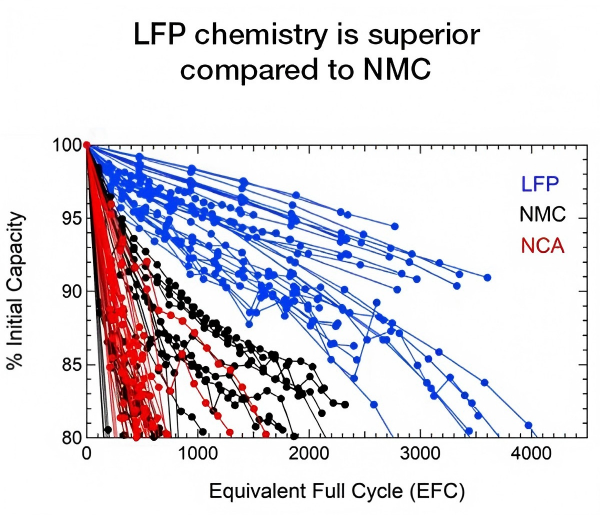
Figure 1 LFP vs NCM cycle life degradation curve
How to test battery capacity and life
The core principle of capacity testing is Coulomb counting: discharge a fully charged battery at a constant current, record the discharge time, and calculate the actual discharge capacity using the formula Capacity = Current × Time, then compare it with the nominal capacity to obtain capacity retention. Capacity tests are typically performed under constant temperature conditions (25℃ ± 2℃) using different C‑rates (0.2C, 0.5C, 1C, etc.) to evaluate specific application needs. Temperature has a significant effect on capacity; at -20℃, battery capacity may drop to 50%-70% of its room‑temperature value.
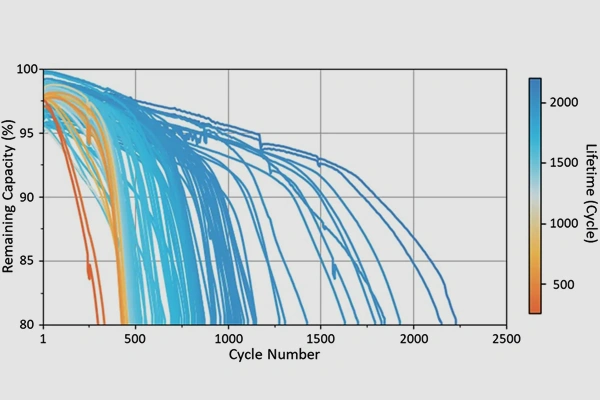
Cycle life testing involves repeated charge‑discharge cycles under specified conditions (current, voltage, temperature) to track the capacity fade curve. The test is stopped when capacity falls to 80% (or 70%) of the initial capacity, and the number of cycles recorded is the cycle life. SOH (State of Health) is typically evaluated based on two core indicators: capacity fade and internal resistance growth. Joint estimation of multiple life indicators is an important direction for future BMS algorithms.
Comparison of capacity and life performance parameters of various batteries
According to publicly available measured data, after five years of use, the average capacity retention of LFP batteries is 83.7%, while that of NCM batteries is only 71.4%. In terms of DC internal resistance, LFP increases by about 38%, whereas NCM increases by as much as 67% – doubling the internal resistance means more energy turns into heat, causing the battery to "heat itself" in winter, further accelerating aging. Laboratory section analysis from a 600,000‑km bus road test shows that lithium plating thickness on the LFP anode is 4.2 μm, compared to 7.8 μm for NCM; the crack density on the NCM cathode is 2.6 times that of LFP. Data from research institutions further confirm these trends.
Energy storage scenarios require 3,000‑6,000 cycles, with LFP as the main solution. Grid‑scale energy storage projects, due to shallow depth of discharge and low C‑rates, can achieve actual calendar lives of 15‑20 years. Consumer electronics have the lowest cycle life requirements (300‑500 cycles) but are highly sensitive to volumetric energy density and cost. From a full‑life‑cycle economic perspective, LFP has a cost advantage over NCM.
Impact of AI‑based battery capacity and life prediction on the market
Traditional SOH prediction methods rely on physical models such as equivalent circuit models (ECM). Constrained by the nonlinear aging of battery materials and the variability of operating environments, these methods struggle with modeling complex systems and suffer from weak cross‑scenario generalization. Machine learning (AI) is becoming the core driver to break through these bottlenecks. Models based on SVR, GPR, and CNN‑LSTM hybrid neural networks have achieved remarkable results in battery health management. Combining incremental capacity analysis (ICA) with GPR, only about four diagnostic measurements during the battery's lifetime achieve an NMAE mean error of 1.3% for SOH prediction. Integrating dQ/dV analysis with hybrid deep learning architectures maintains high SOH prediction accuracy even under inconsistent fast‑charging protocols.
The application of physics‑informed neural networks (PINN) further enables multi‑task prediction synergy – the MAPE for SOH estimation is as low as 0.75%, and the MAE for RUL prediction is 104 cycles. These advances allow OEMs to detect abnormal battery batches earlier, assess remaining life value more accurately, and promote used‑car market activity. Energy storage stations can optimize charge‑discharge strategies based on life prediction, extend service life, and increase IRR. Battery manufacturers can leverage big data feedback to optimize cell design, reduce warranty costs, and shorten R&D cycles.
Challenges of AI prediction also cannot be ignored: massive high‑quality data are needed to train models; data vary greatly across different chemistries and operating conditions; the internal parameters of deep learning models such as LSTM are difficult to interpret physically, leading to opaque decision‑making; model generalization is limited by training data, requiring retraining and recalibration when deployed in new scenarios.
Capabilities required of battery test equipment
To meet the multiple technical demands of capacity fade prediction, life assessment, and AI‑assisted aging monitoring, modern high‑precision battery test equipment must possess the following capabilities:
Ultra‑high precision and wide dynamic range. The accuracy of test equipment directly affects the quality of basic data for SOH and RUL estimation. Voltage accuracy must be at the level of ±0.02% F.S., and current accuracy at ±0.05% F.S.; standby power measurement requires microampere‑level current acquisition to capture tiny self‑discharge signals. Current industry standards for BMS testing already require voltage measurement accuracy to reach the 0.1 mV era.
Multi‑mode comprehensive test capabilities. The equipment must support DC internal resistance (DCIR) testing (for aging diagnosis), dQ/dV differential capacity analysis (for lithium plating and structural degradation analysis), AC internal resistance (ACIR) testing, and electrochemical impedance spectroscopy (EIS) (for interface aging diagnosis). Combined with BTS software that automatically links charge‑discharge data with environmental chamber data, it can accurately assess the impact of temperature rise on cycle life.
Multi‑channel synchronization and remote collaboration. Large‑scale cycle life testing requires hundreds of channels to run simultaneously with centralized data analysis. Remote control and cloud‑based LIMS systems allow R&D personnel to monitor test progress from different locations.

Figure 2 NEWARE LIMS system schematic diagram
Digital interfaces and data integration. Test data should seamlessly connect with machine learning algorithms to achieve automatic SOH estimation and RUL prediction, and provide flexible programming interfaces for new battery types. Moreover, series such as the CE‑6000 have already achieved bidirectional CC‑CV integrated charge‑discharge steps with smooth, spike‑free switching, providing a precise hardware foundation for long‑duration cycle life testing.
Conclusion
From precise charge‑discharge cycling in the laboratory to online OCV estimation during real‑world EV driving, battery capacity and life prediction methods are undergoing a paradigm shift from "physics‑based modeling" to "data‑driven" approaches. The integration of AI has greatly improved prediction accuracy and cross‑scenario adaptability, accelerating battery R&D, manufacturing, and application iteration. High‑performance battery test equipment is the foundation that makes all of this possible.
Supplement: Some of the information presented above was obtained from the Internet. We are very sorry if there is any infringement! You can contact us for deletion!