Emerging wearable devices' battery challenges
Smart rings and AI glasses are the fastest‑growing new categories in wearable devices. Smart rings must fit batteries into an extremely small annular space, placing very high demands on irregular‑shaped, curved, and ultra‑thin batteries. AI glasses face the contradiction between lightweight design and high power consumption – on‑device AI, camera, audio, and communication loads drive up power requirements, so batteries must provide sufficient energy while being thinner and lighter.
Smart ring battery specifications
Smart ring battery capacities typically range from 12 to 23.5 mAh, varying by ring size:
| Brand/Model | Ring Battery | Charging Case Battery | Battery Life |
| Samsung Galaxy Ring | 18‑23.5 mAh (varies by size) | / | Up to 7 days |
| RingConn Gen 2 | 12‑15 mAh (varies by size) | 500 mAh | 150 days with case |
| Cipney Smart Ring | 14‑18 mAh | / | / |
| QuzzZ Ring | Rechargeable polymer Li‑ion | / | / |
Smart ring batteries typically use a curved design to conform to the finger’s annular structure. The RingConn smart ring battery has a capacity of 3.8V/22mAh, while its charging case battery is rated at 5V/500mAh. The Samsung Galaxy Ring’s battery capacity ranges from 18 to 23.5 mAh (depending on ring size), providing up to 7 days of continuous use.
AI glasses battery specifications
AI glasses batteries are typically distributed inside the temple arms, using pouch lithium‑ion cells:
| Brand/Model | Battery Specifications | Features |
| INMO GO AR | 3.8V/110mAh × 2 | Dual‑battery design, 7‑hour battery life |
| Looktech AI | 3.85V/160mAh | Single‑temple power supply |
| Xiaomi AI Glasses | 3.87V/255mAh | Jinshajiang battery, 8.6‑hour battery life |
The INMO GO AR smart glasses contain two identical lithium batteries (model HT400832V), each with a nominal voltage of 3.8V and rated capacity of 110mAh (energy 0.42Wh). The Looktech AI smart glasses have a 3.85V/160mAh lithium battery in the left temple arm. The Xiaomi AI Glasses have a lithium‑ion polymer battery pack in the right temple arm, with a nominal voltage of 3.87V, rated capacity of 255mAh, and rated energy of 0.99Wh.
What equipment is needed to test irregular/flexible batteries?
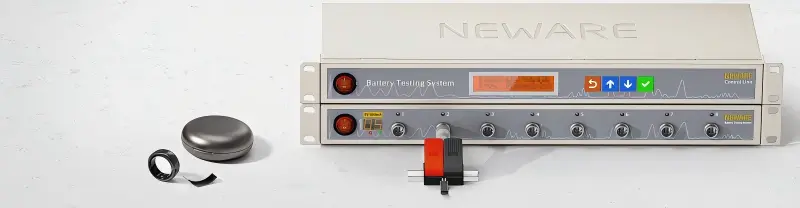
Dedicated fixtures for curved and irregular‑shaped batteries
Smart ring batteries use curved designs, and AI glasses batteries must fit into temple arms – traditional flat‑surface test fixtures are not suitable. Testing equipment must be equipped with customized curved‑battery fixtures and temple‑arm battery fixtures.
Flexible bending test equipment
Flexible lithium batteries need to simulate repeated bending and folding under wearable conditions. Testing equipment must be equipped with programmable bending testers or custom servo devices capable of testing electrical performance changes at different bending angles (90°, 180°, etc.). Flexible material comprehensive testers include four motion test modes: tension, bending, flexing, and torsion.
High‑precision measurement of extremely small currents
Smart ring batteries have capacities of only 12‑23.5 mAh, with standby currents as low as nanoampere levels. Testing equipment must offer higher current measurement precision than standard wearable testing.
Safety performance testing
Smart rings are in direct contact with the skin, so battery safety is critical. Testing must comply with IEC 62133 standard requirements, covering overcharge, over‑discharge, short circuit, thermal shock, vibration, and crush tests.