eVTOL battery requirements 2026: why standard ev testing fails
Entering 2026, Urban Air Mobility (UAM) is no longer science fiction. With global pioneers pushing for commercial certification, the focus has shifted to the "heart" of these aircraft: the high-power battery pack.
However, a critical engineering realization has emerged—standard electric vehicle battery testing protocols are fundamentally inadequate for the extreme demands of vertical flight. Research confirms that eVTOL applications require batteries to possess both high energy density and ultrafast charging with high-power discharge capabilities.
This article will explore why pulse discharge testing has become the make-or-break factor for eVTOL certification programs, and how advanced battery testing solutions are supporting the next generation of airworthy energy storage systems.
What is eVTOL? a quick primer
eVTOL stands for electric Vertical Take-Off and Landing aircraft. Often called "flying cars" or "air taxis," these vehicles are designed to take off and land vertically like helicopters but fly forward like airplanes—all powered by batteries.
Think of them as drone technology scaled up to a passenger-carrying level. Companies like Joby Aviation, Archer, and EHang are developing eVTOL aircraft, aiming to revolutionize urban transportation by taking traffic to the skies.
What is the key difference? Unlike the complex mechanical systems of traditional helicopters, eVTOL aircraft rely entirely on battery packs for lift, cruise, and landing—making battery performance directly related to flight safety.

The pulse challenge: the necessity of 1000Hz high-fidelity sampling
why evtol discharge differs from evs
An electric vehicle's peak power lasts seconds during highway merging. An eVTOL aircraft must deliver sustained high power during critical flight phases—especially when fighting gravity:
| Flight Phase | Duration | Discharge Rate | Why It Matters |
| Take-off | 30-90 seconds | 10C-15C | Lifting vertically against gravity |
| Hover | 2-5 minutes | 8C-12C | Energy-intensive altitude maintenance |
| Emergency landing | 30-60 seconds | 20C-30C+ | Extreme power reserves for safety |
These fast discharge requirements place unprecedented stress on battery chemistry. Recent research highlights that advanced formulations, such as LiFSI-based electrolytes, markedly outperform conventional Gen-2 (LiPF₆) options under these extreme conditions.
High-power discharge and electrolyte performance
The fast discharge requirements for eVTOL applications place unprecedented stress on battery chemistry. Recent research published in the Journal of Power Sources highlights that electrolyte formulations play a critical role in enabling high-rate discharge capabilities . Conventional electrolytes like Gen-2 (LiPF₆) show limitations under extreme discharge conditions, while advanced formulations such as LiFSI-based electrolytes demonstrate enhanced power delivery and cathode stability .
The data blind spot in high-rate discharge testing
Here's the engineering challenge: Standard battery cyclers with 10Hz sampling rates cannot capture millisecond-level voltage dynamics during these extreme transitions. When a battery sags under massive load, the recovery behavior contains critical information about:
Internal resistance evolution
Lithium plating onset (a key failure mechanism)
Thermal gradient formation
Early degradation patterns
If your hardware cannot resolve these micro-events, your AI models cannot predict failures—and in urban air mobility, failure prediction is non-negotiable.
High-fidelity pulse capture solutions
Advanced battery test systems engineered for eVTOL applications offer:
1000Hz recording frequency (1ms sampling across all channels)
Current response time ≤100μs (10%-90% rise time)
Synchronized voltage/current/temperature capture
These capabilities provide the "Source of Truth" for state-of-health algorithms and digital twin models. During a 20C pulse, voltage dynamics evolve in milliseconds. A 10Hz cycler captures only 10 points per second, potentially missing the exact moment of lithium initiation. 1000Hz capture provides 100x more resolution, revealing the true electrochemical response that determines flight safety.
DO-311A compliance and eVTOL battery certification requirements
In 2026, airworthiness is non-negotiable. Regulatory bodies worldwide have established stringent requirements for aviation battery systems:
| Regulation | Agency | Key Requirement |
| DO-311A | FAA (USA) | Thermal runaway containment, altitude testing |
| SC-VTOL Issue 2 | EASA (Europe) | Enhanced category certification |
| AP-21-AA-2023-12R1 | CAAC (China) | Full lifecycle traceability |
Thermal runaway testing requirements
DO-311A Section 5.6 explicitly mandates thermal runaway containment testing. This means:
Triggering a cell into thermal runaway while installed in the pack
Containing the event to prevent propagation
Monitoring all parameters with high-fidelity sensors
Documenting the results with auditable traceability
Integrated compliance testing solutions
Advanced testing systems bridge the gap between battery testing and certification by integrating:
Hardware integration
High-precision cyclers with current ranges from 1mA to 2000A+ (parallel-configurable for MW-scale packs)
Explosion-proof environmental chambers with integrated gas venting
Altitude simulation capability (up to 80,000 ft equivalent)
Software intelligence
LIMS (Laboratory Information Management Systems) that automate report generation
Audit-ready data formats matching DO-311A submission requirements
Digital signature support for data integrity verification
During recent certification programs with leading eVTOL manufacturers, integrated testing solutions have reduced documentation preparation time by over 70% while providing the granular data required for regulatory approval.
Battery passport compliance and data integrity requirements
The digital traceability mandate for eVTOL batteries
The EU Battery Regulation (2023/1542) now mandates a digital "Battery Passport" for all rechargeable batteries over 2kWh entering the European market. For eVTOL OEMs, this means:
Every cell's "birth certificate" (formation data) must be permanently linked
Performance history must be transparent and traceable
Carbon footprint declarations require verified data
Similar regulations are emerging in the United States, United Kingdom, China, and Japan.
Digital twin readiness for battery lifecycle management
Advanced AI+BI software suites serve as the digital backbone for compliance strategies:
From formation to retirement
Birth certificate generation: Formation cycles with <0.02% accuracy create the immutable baseline
In-life monitoring: Every pulse test, every cycle, every thermal event is timestamped and encrypted
End-of-life characterization: Precise capacity fade tracking enables second-life valuation
Seamless integration
API-first architecture connects directly to Battery Passport frameworks
Blockchain-ready audit trails ensure data cannot be retroactively modified
Standardized data schemas compatible with Catena-X, GAIA-X, and other data spaces
By capturing noise-free data from initial formation to end-of-life cycles, eVTOL manufacturers can protect their brand from the "Compliance Trap"—avoiding costly re-certification due to incomplete data trails.
Technical comparison: EV vs. eVTOL battery testing requirements
| Feature | Standard EV | eVTOL Requirement |
| Peak Discharge Rate | 3C-5C sustained | 8C-15C sustained, 20C-30C pulse |
| Dynamic Response (10%-90%) | 1ms-10ms | ≤500μs to prevent voltage collapse |
| Sampling Rate | 1Hz-10Hz | 100Hz-1000Hz for transient capture |
| Measurement Accuracy | 0.1% typical | 0.02% for impedance tracking |
| Safety Standard | ISO 6469 / UN38.3 | DO-311A / SC-VTOL (propagation testing) |
| Data Format | CSV / Excel | Audit-ready with cryptographic integrity |
| Environmental Integration | Temperature chamber | Altitude + temperature + containment |
Measurement architecture for high-precision battery testing
Beyond specifications: the engineering difference
While specification tables tell part of the story, the real differentiator lies in measurement architecture:
| Parameter | Standard Cycler | High-Performance Cycler |
| Sampling Method | Multiplexed (channel hopping) | Dedicated ADCs per channel |
| Response Time | 1-10ms (firmware limited) | ≤100μs (hardware accelerated) |
| oise Floor | >50μV | <5μV (active filtering) |
| Synchronization | ±100ms (network dependent) | 1μs (hardware clock sync) |
Real-world impact: pulse testing comparison
Consider a 30C, 5-second pulse test on a 50Ah eVTOL cell:
10Hz cycler: Captures 50 points during the pulse. Voltage minimum may occur between samples. Recovery dynamics are aliased.
100Hz cycler: Captures 500 points. Better, but still undersamples the critical first 100ms of recovery.
1000Hz cycler: Captures 5,000 points. Every millisecond of voltage response is recorded. DC internal resistance can be calculated at multiple time constants. Lithium plating signatures become visible.
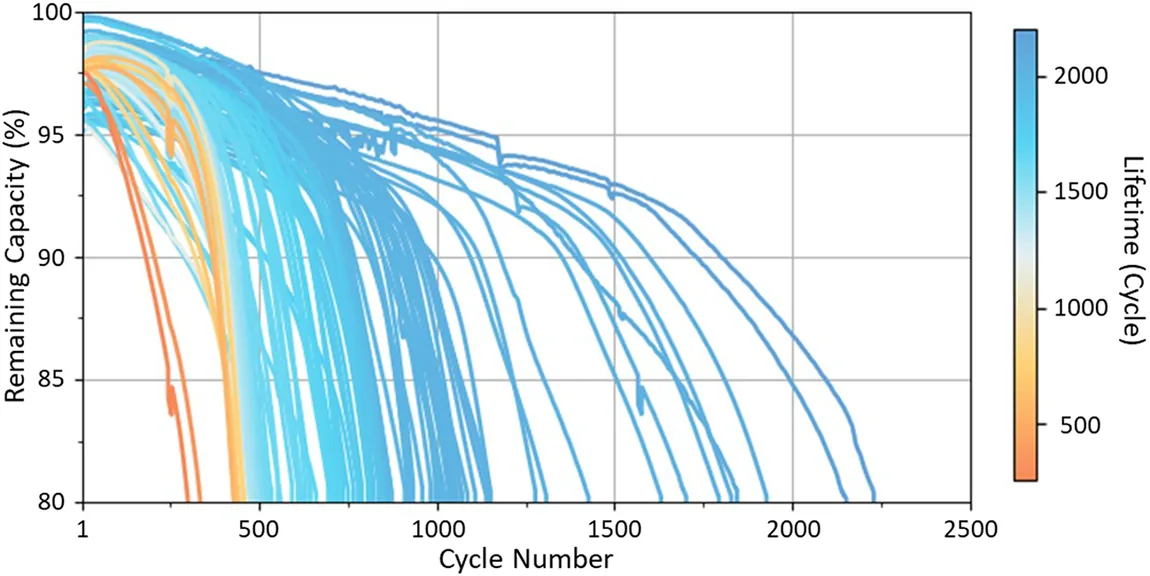
The result: Engineers using high-fidelity testers identify degradation mechanisms 3-6 months before they appear in field data, enabling proactive design iterations. Advanced characterization techniques—including XRD, SEM, and XANES—reveal degradation features such as lattice contraction, particle fracturing, and heterogeneous oxidation states that correlate with electrochemical trends .
5. Electrolyte formulations for high-rate eVTOL applications
The role of electrolyte chemistry in fast discharge
Recent investigations into electrolyte formulations for urban air mobility applications demonstrate that electrolyte composition significantly impacts discharge processes and rate capability . Studies comparing conventional Gen-2 electrolyte (1.2 M LiPF₆ in EC:EMC) with dual-salt LiTFSI-LiBOB-based formulations reveal:
LiFSI-based electrolytes markedly outperform conventional electrolytes under high-rate discharge
Enhanced power delivery and cathode stability are achievable with optimized formulations
However, long-term cycling reveals new degradation pathways, including current collector corrosion unique to certain formulations
These findings emphasize the importance of balancing performance with stability through integrated design and characterization strategies—precisely the kind of insights that high-precision pulse discharge testing can reveal.
Conclusion: precision that flight safety demands
As the skies become the new highway in 2026, the margin for error is zero. Urban Air Mobility is not just another transportation mode—it is a fundamental shift in how we move through cities, and it must be built on an unshakeable foundation of safety.
In eVTOL battery testing, what you cannot measure, you cannot manage. The milliseconds of voltage sag during a vertical take-off, the microvolts of impedance rise after 500 cycles, the thermal gradients during a 30C pulse—these subtle signals contain the difference between certification and re-design, between fleet deployment and grounded aircraft.

Whether you are characterizing next-generation solid-state cells or validating megawatt-scale propulsion packs, precision testing delivers the "Source of Truth" that engineering teams, certification authorities, and passengers deserve. As research continues to reveal the complex relationship between electrolyte composition and high-power discharge requirements, the ability to capture high-fidelity pulse data becomes increasingly critical .
The future of flight is electric. The foundation of electric flight is precision testing.