Introduction: do you really understand the meaning of BESS?
If you are searching for "BESS meaning" or "what is BESS," you probably already know it has something to do with "batteries" and "energy storage." But what you may not know is this: BESS is much more than just a pile of batteries.
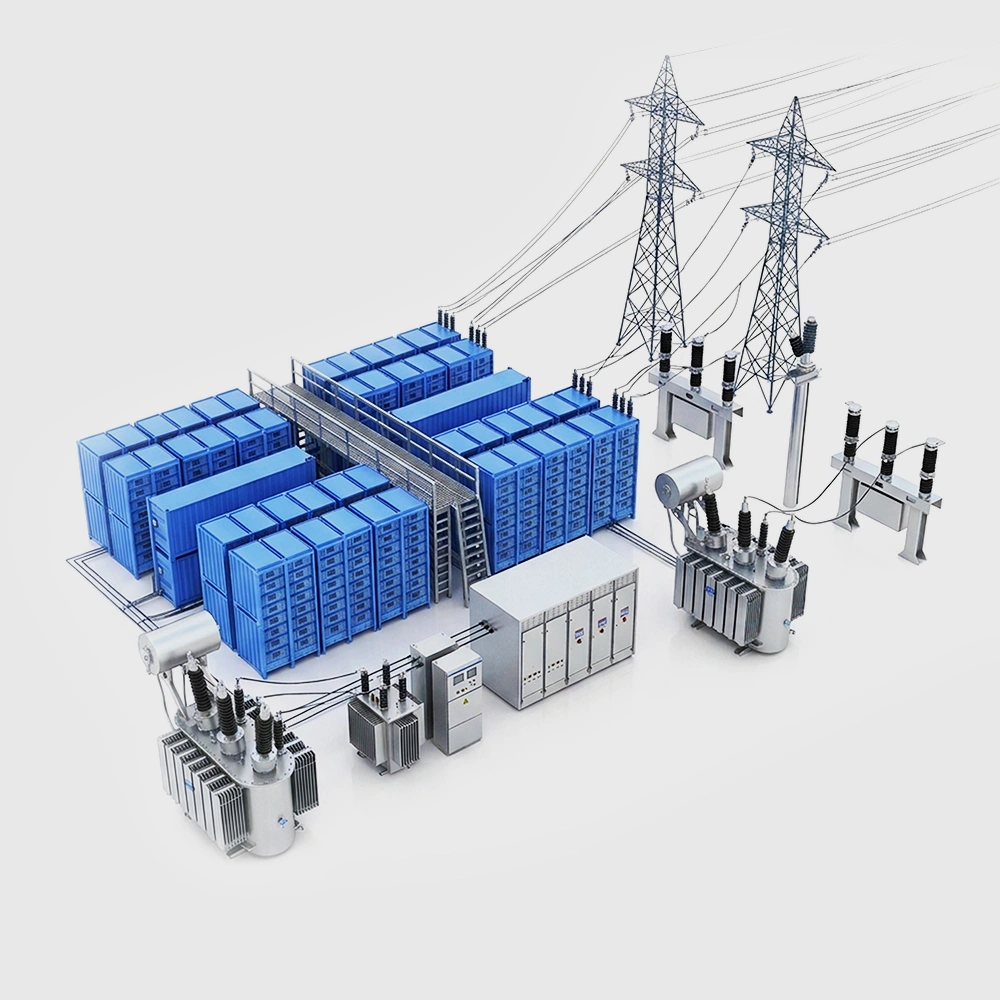
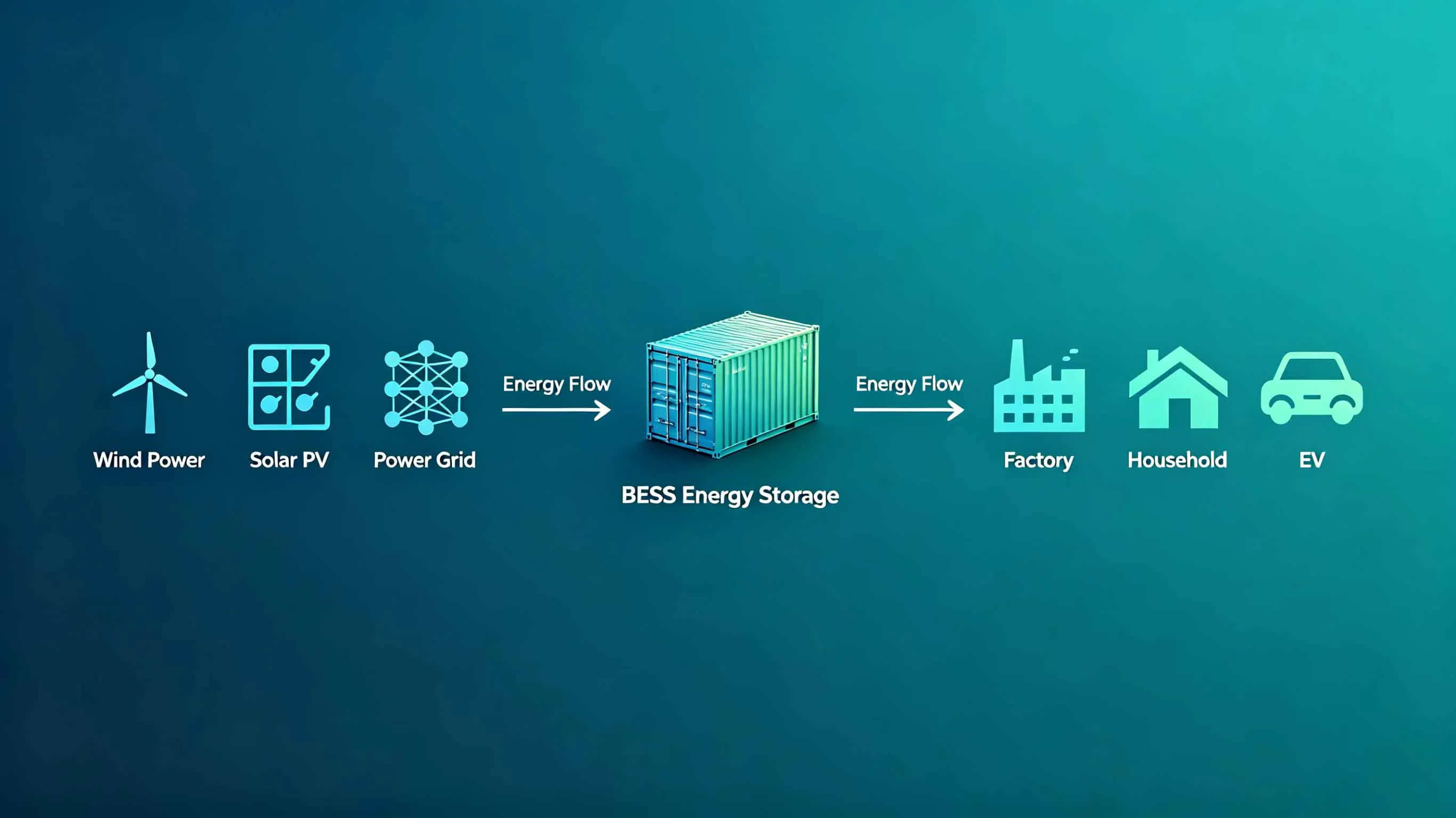
A Battery Energy Storage System (BESS) is a technology that stores electrical energy in rechargeable batteries and releases it when needed. Think of it as a time-shifter for electricity — storing cheap wind power generated in the early morning and releasing it during expensive evening peak hours. From a home solar companion to a hundred-megawatt grid-scale station, BESS is becoming a core piece of infrastructure in the global energy transition.
However, as BESS is deployed at large scale worldwide, one unavoidable issue has become an industry focal point: thermal runaway and fire safety. This article will clearly explain the definition, components, applications, and — most importantly — the safety (safety essentials) of BESS.
BESS meaning: a clear and simple definition
Official definition of a battery energy storage system
A Battery Energy Storage System (BESS) is typically referred to as a stationary battery system. It can store and release electrical energy with great flexibility. Depending on its design and size, a BESS can perform various roles in the grid, commercial/industrial facilities, or homes.
In simpler terms: a BESS acts like an intelligent electrical reservoir. When there is excess generation (or low electricity prices), it stores energy. When generation falls short (or prices are high), it releases energy. It solves the biggest physical limitation of electricity — that it must be used as soon as it is generated.
Why "System" matters — more than just batteries
Many people mistakenly believe that a BESS is simply a set of batteries. In reality, the word "system" is critical. A complete BESS must include, beyond the batteries themselves:
Power electronics – for AC/DC conversion
Battery Management System (BMS) – monitors and protects the batteries
Energy Management System (EMS) – decides when to charge/discharge for maximum benefit
Metering and communication units – to interact with the grid or electricity markets
Without these components, batteries are just a collection of chemicals, not a usable energy storage system.
How does BESS work?
The simple principle of the Charge-Discharge cycle
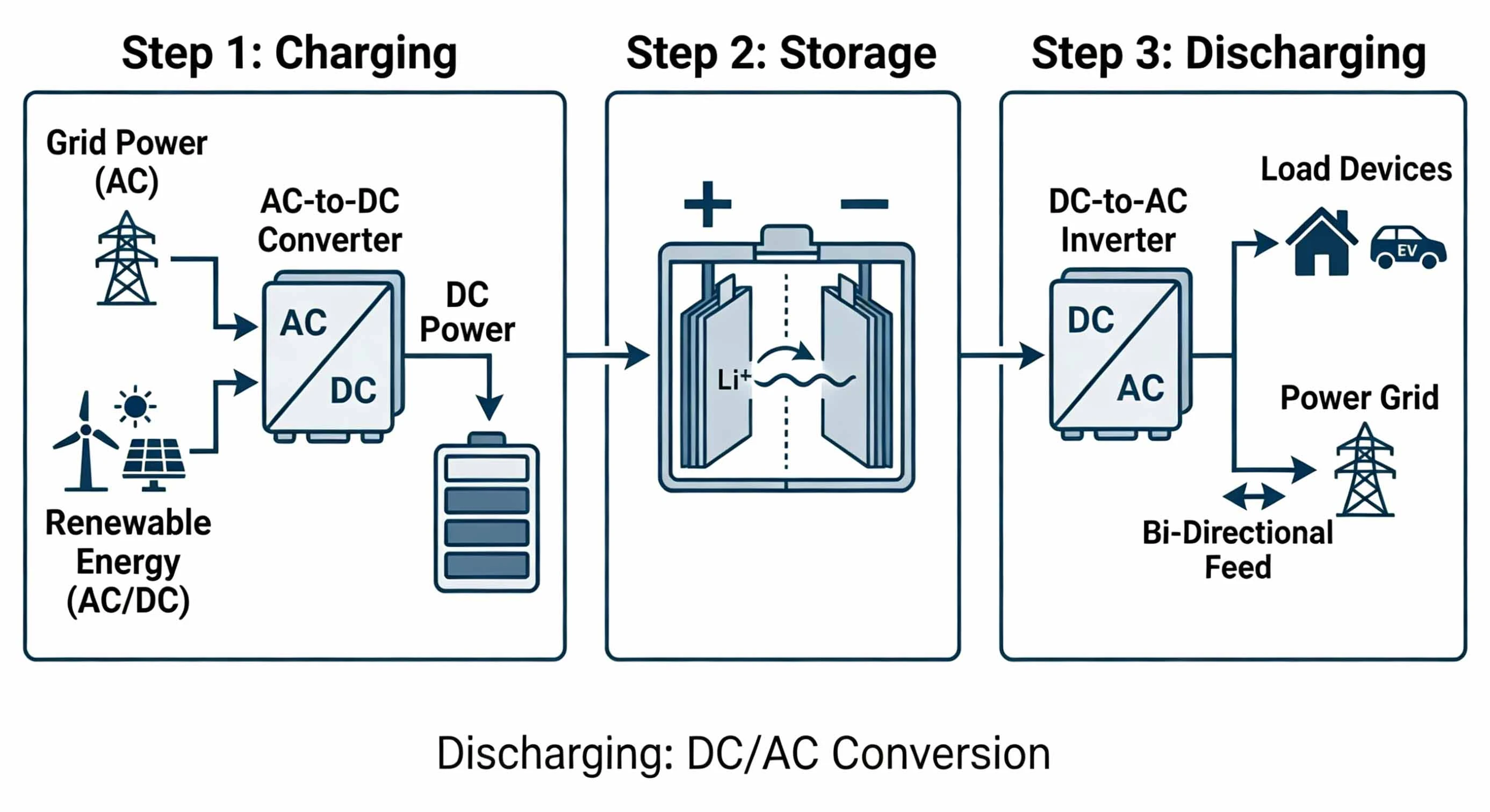
The working process of a BESS can be broken down into three steps:
1. Charging: Alternating current (AC) from the grid or renewable sources (e.g., solar PV) is converted to direct current (DC) by power electronics and then stored as chemical energy in the batteries.
2. Storage: The batteries hold the chemical energy, waiting on standby for instructions.
3. Discharging: When the grid needs power or electricity prices are high, the stored chemical energy is converted back to DC, then inverted to AC, and supplied to loads or the grid.
The overall round-trip efficiency is typically between 85% and 95%, depending on the battery technology and operating conditions.
The four core components of any BESS
Any usable BESS, regardless of size, contains the following four components:
| Component | Function | Simple Analogy |
| Battery cells | Store chemical energy | The core "container" |
Power Conversion System (PCS) | Bi-directional AC/DC conversion | The interpreter (lets the battery and grid "talk") |
Battery Management System (BMS) | Monitors voltage, current, temperature, prevents anomalies | The safety guard |
Energy Management System (EMS) | Controls charging/discharging based on price or grid signals | The commercial brain |
Among these, the BMS is the first line of defense for safety — it can disconnect the circuit or trigger alarms before the battery becomes abnormal.
What battery technologies are commonly used in BESS?
Several battery technologies are available for BESS today, each with its own advantages and trade-offs. The choice depends on the application, budget, and safety requirements.
| Battery Type | Energy Density | Cycle Life | Safety | Primary Applications |
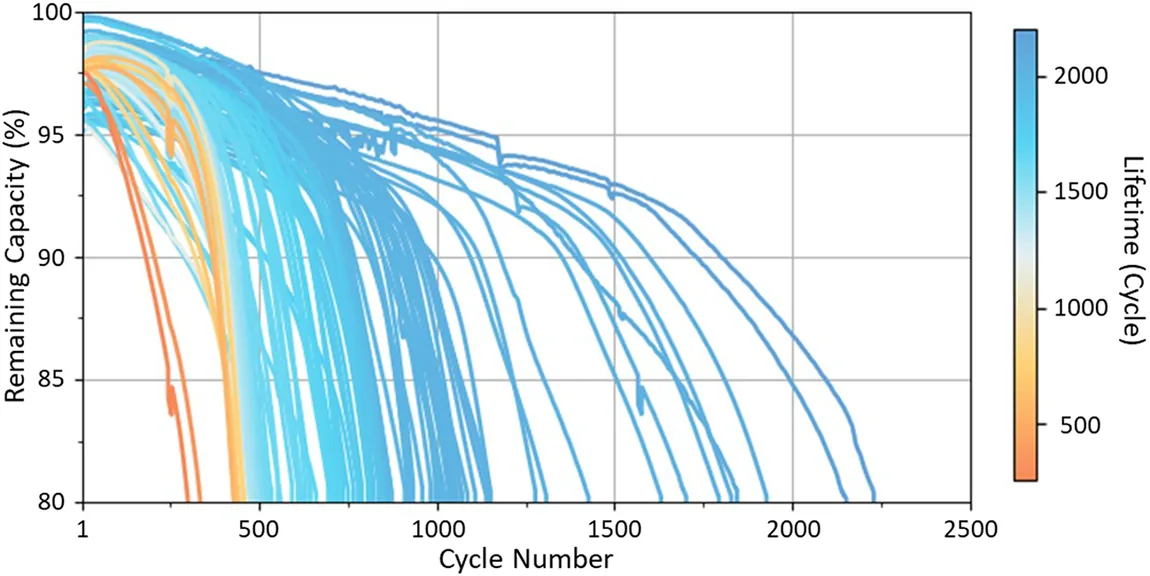
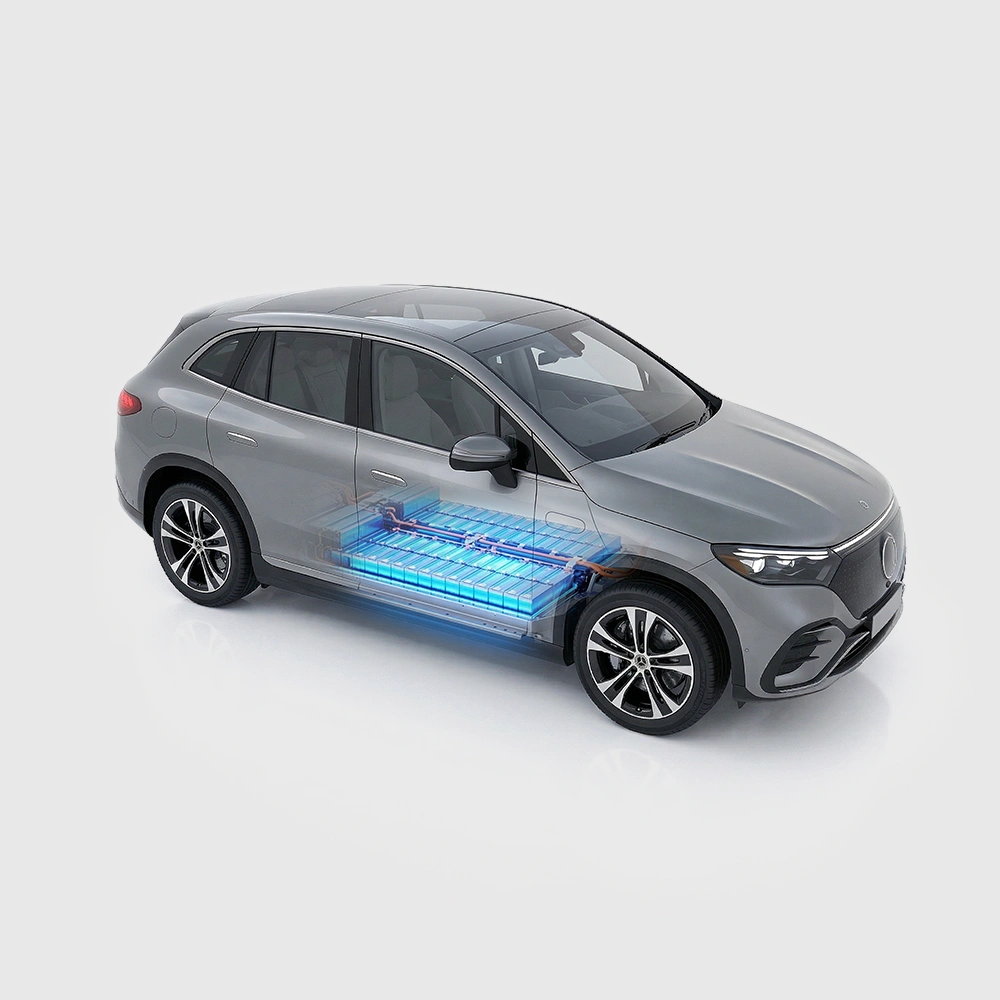
| Lithium-ion | Very high | Long (3,000-8,000 cycles) | Medium (thermal runaway risk exists) | Mainstream grid, C&I, home storage |
| Lead-acid | Low | Short (500-1,000 cycles) | Relatively high | Low-cost backup power (being phased out) |
| Sodium-ion | Medium | Fairly long | Relatively high | Low-cost stationary storage |
| Flow battery | Low | Very long (>15,000 cycles) | Very high | Long-duration storage (4-12 hours) |
What is BESS used for? real-world applications
BESS is already widely deployed in the following areas:
Grid frequency regulation and peak shaving
Frequency regulation: Grid frequency must be maintained at 50Hz (or 60Hz). BESS can respond in milliseconds, absorbing or releasing power to stabilize frequency.
Peak shaving: During peak demand, BESS discharges, avoiding the need to start expensive peaker plants.
Renewable energy integration
Smoothing intermittent output from wind and solar
Storing excess solar energy during the day for use at night
Reducing curtailment of wind and solar
Commercial & industrial peak shaving and demand management
Businesses charge during low-price periods and discharge during high-price periods, directly saving on electricity bills
Managing demand for high-power equipment (e.g., EV chargers, cold storage) to reduce transformer capacity charges
Residential solar + storage
Increasing self-consumption of solar PV (from ~30% to over 70%)
Providing emergency backup power during outages
Thermal runaway and fire safety: an issue BESS must confront
What is thermal runaway?
Thermal runaway is a phenomenon where, due to internal or external causes (such as overcharging, an internal short circuit, physical puncture, or high ambient temperature), a lithium-ion battery enters an uncontrollable chain reaction of heat generation. The battery temperature can rapidly rise to 600-1000°C (1112-1832°F), potentially leading to fire or even explosion.
In simple terms: under normal operation, the battery's internals are stable. But if protection fails, the electrolyte decomposes, the positive and negative electrodes react and release oxygen, and the separator melts — the cascade becomes unstoppable.
Why is thermal runaway a core concern for BESS?
Three main reasons:
1. Incidents have occurred – BESS fires have happened in South Korea, the United States (Arizona), and China (Beijing), resulting in casualties and large financial losses.
2. Scale amplifies risk – A megawatt-scale BESS may contain thousands or even tens of thousands of cells. Thermal runaway in one cell can propagate to an entire rack or even an entire container.
3. Difficult to extinguish – Lithium-ion battery fires are chemical fires, generating their own oxygen. Ordinary fire extinguishers (dry chemical, CO₂) can put out the flames but cannot prevent re-ignition. Water can cool the batteries but may cause short circuits or produce hydrogen gas.
Five key measures to prevent thermal runaway in BESS
Professional BESS projects manage risk through the following design measures:
High-grade BMS – Real-time monitoring of voltage, current, and temperature for each cell or module, with automatic circuit disconnection upon detecting anomalies.
Cell-level gas detection – Before thermal runaway becomes visible (even before smoke appears), batteries release specific gases. Sensors can provide several minutes of early warning.
Advanced thermal management – Liquid cooling is more efficient and uniform than air cooling, significantly reducing temperature differences between cells and delaying the onset of thermal runaway.
Physical isolation and fire compartments – Fire-rated barriers between battery racks and between containers prevent a single point of failure from propagating.
Specialized fire suppression systems – Mainstream solutions include Novec 1230 (FK-5-1-12) or aerosol agents, which rapidly cool and suppress re-ignition. Explosion venting and combustible gas exhaust systems are also required.
Key conclusion: Thermal runaway is an inherent risk of lithium-ion BESS, but it is manageable through proper design and operation. International standards such as NFPA 855 and UL 9540A impose strict requirements for thermal runaway testing and fire protection design of energy storage systems.
Thermal runaway risk comparison across battery technologies
Sodium-ion batteries: Significantly better thermal stability than lithium-ion, with a higher thermal runaway threshold and lower heat generation.
Flow batteries: The electrolyte is water-based, so there is almost no thermal runaway risk — but they are large and have low energy density.
Lead-acid batteries: Very low thermal runaway risk (they may swell and bulge but rarely catch fire).
For the next 5-10 years, lithium-ion batteries will remain the mainstream choice for BESS. The key is not to avoid the risk, but to manage it properly.
BESS vs. other energy storage technologies
| Technology | Response Speed | Discharge Duration | Lifespan | Typical Applications |
BESS (lithium-ion) | Milliseconds | 0.5-4 hours | 10-15 years | Frequency regulation, peak shaving, backup power |
| Pumped hydro | Minutes | 6-12 hours | 50+ years | Large-scale grid peak shaving |
| Flywheel | Milliseconds | Seconds to minutes | 20+ years | UPS, short-duration high-frequency regulation |
| Hydrogen storage | Slow | Seasonal | Long | Seasonal, long-duration storage |
BESS's greatest advantages are fast response and flexible deployment, making it ideal for minute-to-hour regulation. It is not a replacement for pumped hydro — the two technologies complement each other.
Conclusion: what does BESS mean for the future of energy?
So, back to the original question — what does BESS really mean?
Technically, it is an integration of batteries, power electronics, and control systems. But from a broader perspective, BESS is the indispensable flexibility provider for the renewable energy era. Without energy storage, high shares of wind and solar cannot reliably supply the grid. Without storage, the full potential of distributed energy resources cannot be unlocked.
At the same time, large-scale BESS deployment must face and address safety risks head-on. Thermal runaway is not a death sentence for lithium-ion technology — it is an engineering problem that must be rigorously managed. Through proper design, certification, and operation, BESS can absolutely become a safe and reliable piece of grid infrastructure.
Whether you are a grid planner, a commercial/industrial energy manager, or a homeowner considering solar+storage, understanding BESS — including its capabilities, its limitations, and its risks — is the first step toward a clean, reliable energy future.
FAQs
Q1: How long does a BESS typically last?
A: It depends on the battery technology and usage patterns. A lithium-ion BESS typically has a design life of 10-15 years, or 3,000-8,000 charge-discharge cycles (based on 80% capacity retention). Lead-acid batteries have a shorter lifespan, around 500-1,000 cycles.
Q2: Is a residential BESS worth installing?
A: It depends on your local electricity rate structure, whether you have a solar PV system, and your household's consumption patterns. If the peak-to-off-peak price difference is significant, or if you have solar and the feed-in tariff is low, a residential BESS can increase self-consumption through peak shaving. Payback periods are typically 5-10 years.
Q3: Can a BESS explode or catch fire?
A: Lithium-ion BESS does carry a thermal runaway risk. However, with proper design (high-quality BMS, liquid cooling thermal management, gas detection, fire barriers, and specialized fire suppression systems) and strict operation and maintenance procedures, the risk can be controlled to a very low level. This is why choosing qualified suppliers and adhering to international standards (such as NFPA 855 and UL 9540A) is critical.
Q4: Can a BESS completely replace the grid?
A: No. A BESS performs time shifting of electricity — it does not generate energy. It must be charged from an external source before it can discharge. Going completely off-grid requires a very large BESS paired with solar or wind generation, plus sufficient capacity to handle consecutive cloudy or windless days, which is extremely expensive. The vast majority of BESS projects remain grid-connected.
Q5: How are BESS recycling and environmental issues handled?
A: After lithium-ion batteries degrade to below 80% capacity, they can be repurposed for applications with lower energy density requirements (such as low-speed EVs or communication base station backup power). Eventually, they enter the recycling stage, where lithium, cobalt, nickel, copper, and other metals are extracted. Both the European Union and China have introduced recycling regulations for power and storage batteries, requiring manufacturers to take responsibility for recycling.
Q6: Can I install a BESS myself?
A: Not recommended. A BESS involves high-voltage electrical connections, thermal management, BMS configuration, and fire safety design. Improper installation can lead to fire, electric shock, or equipment damage. Installation must be completed by a licensed electrician or professional energy storage installer.