What is a NiMH battery: definition & principles (2026)
Definition: A NiMH battery (Nickel-Metal Hydride) is a high-safety rechargeable alkaline battery that uses nickel oxide hydroxide as the positive electrode and a hydrogen-absorbing alloy as the negative electrode. In 2026, it remains the premier choice for applications requiring extreme thermal stability and environmental compliance.
Core components
Positive electrode: Constructed from nickel oxide hydroxide (NiOOH).
Negative electrode: A metal alloy capable of absorbing hydrogen.
Electrolyte: A potassium hydroxide (KOH) alkaline aqueous solution.
Nominal voltage: Typically 1.2V per single cell.
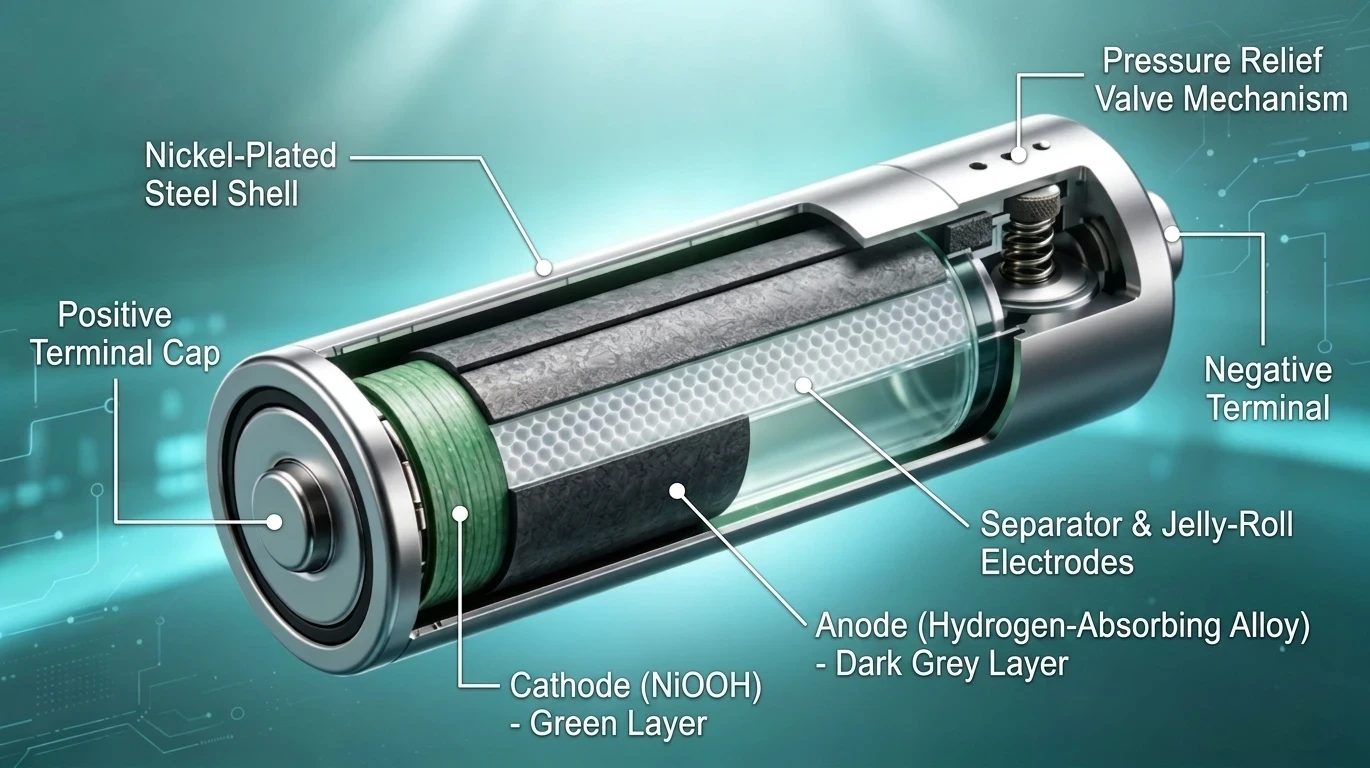
3D Technical Cross-section Diagram of AA NiMH Battery
NiMH Charge-Discharge dynamics
Understanding the performance of NiMH batteries can be achieved through a direct look at their typical electrochemical data curves. The following discharge cycle data demonstrates the stability and reversibility of the NiMH system under various overcharge conditions.
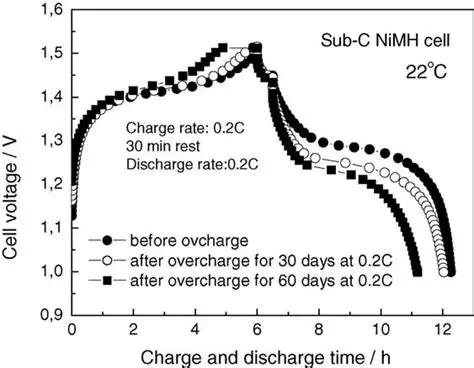
Typical NiMH discharge platform and overcharge resilience data.
Technical analysis
As illustrated in the experimental curves (measured at 22°C with a 0.2C rate), the NiMH system exhibits the following core technical characteristics:
flat discharge platform: It is observed that the battery maintains excellent voltage stability during the discharge process, staying around 1.2V. This feature ensures that end-use devices receive consistent and stable power output until the capacity is nearly exhausted.
robustness under overcharge: The curves compare the performance of a standard cell against those subjected to 30 and 60 days of continuous overcharge. The data shows that despite the capacity shift caused by prolonged overcharging, the NiMH chemistry demonstrates significant ruggedness, maintaining functional discharge characteristics even under non-ideal operating conditions.
The reversible chemistry
This stable performance stems from a highly reversible electrochemical process:
charging: Electric current converts Ni(OH)2 at the positive electrode into NiOOH, while the alloy at the negative electrode stores hydrogen atoms.
discharging: The reaction reverses smoothly; the negative electrode releases hydrogen atoms to produce electrons, and the positive electrode reverts to Ni(OH)2.
safety: The entire process takes place within an aqueous KOH electrolyte. Since this medium is non-flammable, it physically eliminates the risk of thermal runaway, making it an ideal choice for scenarios with stringent safety requirements.
Structural advantages: engineering for safety
The physical architecture of NiMH batteries makes them one of the safest rechargeable chemical systems available today. Their design features multiple protective layers, making them leak-resistant, impact-resistant, and virtually fireproof.
Industrial-grade safety components
| Component | Material / Design | Contribution to Safety & Performance |
| Electrolyte | Potassium Hydroxide (KOH), Aqueous | Non-flammable — Eliminates thermal runaway risks. |
| Safety Valve | High-precision pressure relief valve | Explosion-proof —Releases internal pressure during abnormal charging. |
| Casing | Nickel-plated steel shell | Impact Resistance —Better at withstanding physical trauma than Li-ion pouches. |
| Separator | Alkali-resistant microporous membrane | Short-circuit prevention —Allows ion flow while isolating electrodes. |
2026 market standards: the dominance of AA form factor
In 2026, the AA (LR6) specification remains the most common and practical size for both consumer and industrial markets.
Key technical evolutions in 2026
Increased energy density: Advancements in material processing in 2026 have pushed high-capacity AA NiMH batteries to 2500–3000 mAh. This is sufficient for high-drain devices like professional camera flashes and portable 5G communication modules.
LSD (low self-discharge) technology: Modern LSD NiMH batteries can retain approximately 85% of their charge after one year of storage at 20°C. This effectively solves the previous generation's issue of batteries losing power while sitting in a drawer.
Cycle longevity: A quality NiMH battery supports 500 to 2000 charge-discharge cycles, offering far lower long-term costs compared to disposable alkaline batteries.
System synergy: NiMH main power & LR44 backup
Many modern consumer electronics (e.g., digital calipers, smart meters, electronic scales) utilize a sophisticated dual-battery architecture:
Main Power (Rechargeable NiMH): Typically AA or AAA sizes used to drive motors, sensors, displays, and data transmission.
Backup Power (LR44 / AG13 Button Cell): An alkaline button cell used to maintain the Real-Time Clock (RTC) and system settings while the main batteries are being swapped.
Collaborative Benefit: Since the LR44 only powers the memory and settings, it can last for several years, ensuring you don't have to reset your device every time you charge the main AA batteries.
2026 selection guide: NiMH vs. Alkaline vs. Li-ion
Choosing the right battery in 2026 depends on the frequency of use and the safety requirements of the device.
Performance comparison matrix
| Comparison Item | NiMH (Rechargeable) | Alkaline (Disposable) | Li-ion (Rechargeable) |
| Rechargeable | Yes (500-2000 cycles) | No | Yes (300-500 cycles) |
| Nominal Voltage | 1.2V (Stable) | 1.5V (Drops under load) | 3.6V / 3.7V |
| Safety Risk | Extremely Low | Low (Leaking risk) | Medium (Thermal runaway) |
| Best Used For | Frequently used devices | Occasional / Emergency use | High-power / Lightweight |
2026 consumer application scenarios
Gaming & Entertainment: Xbox/PlayStation controllers, wireless mice, and keyboards benefit from stable voltage and cost savings.
Household Electronics: Cordless phones, electric toothbrushes, and smart door locks stay ready for use due to LSD technology.
Emergency & Safety: Emergency radios and flashlights remain reliable for years without leaking, unlike alkaline alternatives.
Frequently asked questions (FAQ)
Q: Is 1.2V enough for my devices?
A: Yes. While alkaline batteries start at 1.5V, their voltage drops rapidly under load. NiMH provides a stable 1.2V throughout the discharge cycle, often outperforming alkaline in high-drain toys and cameras.
Q: How long will they last?
A: A premium LSD NiMH battery can support up to 2,000 cycles. While theoretically lasting 10-40 years, the typical practical service life is 5 to 10 years.
Q: Can they catch fire?
A: Almost never. Their aqueous electrolyte is non-flammable, and unlike Li-ion, they do not suffer from thermal runaway.
Q: How should I charge them?
A: Always use a "Smart Charger" equipped with –ΔV (Negative Delta V) detection. Avoid cheap "timer-based" chargers as they can overcharge and damage the battery.
Q: Does NiMH pose a fire risk?
A: Extremely low. The use of an aqueous electrolyte (KOH solution) makes the system inherently non-flammable. Unlike Li-ion, NiMH physically eliminates the risk of thermal runaway, making it one of the safest chemistries available.
For more information on professional NiMH testing equipment and experimental data, please visit: [More Test Reports & Equipment Details]