Drone deliveries, passenger commuting via electric vertical take-off and landing (eVTOL) aircraft, and nocturnal light shows by drone swarms—these are not scenes from science fiction, but a new economic form taking shape in the airspace within 1,000 meters above the ground.
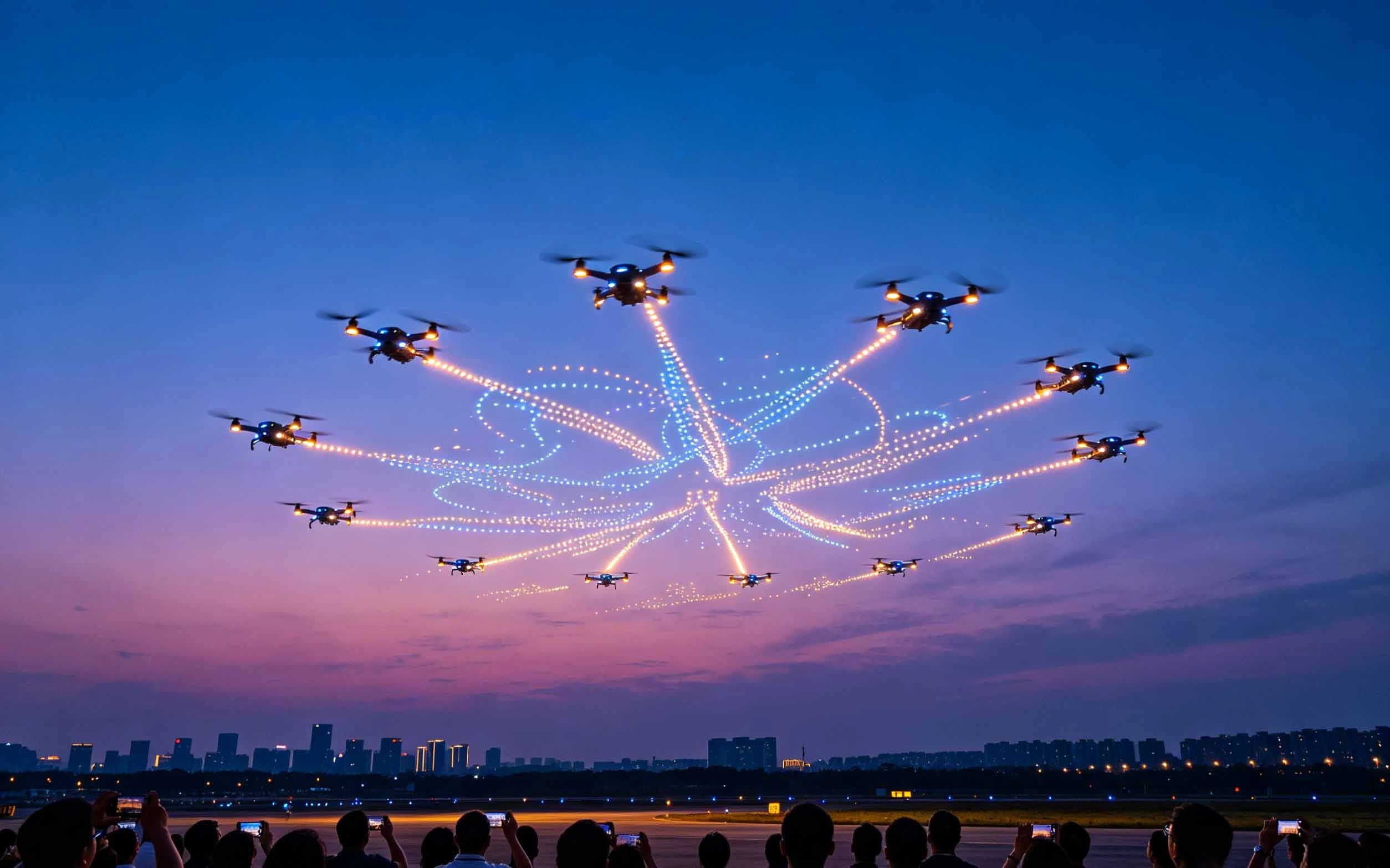
A drone delivers emergency medicine to a site within 15 minutes. An eVTOL aircraft completes a trip from the city center to the airport in just 8 minutes. Hundreds of drones orchestrate dynamic patterns across the night sky.
These scenarios are transitioning from prototype testing into limited commercial operations. Supporting them is an emerging field: the low-altitude economy.
What is the Low-Altitude economy?
Low-altitude airspace typically refers to the space within a vertical distance of 1,000 meters from the ground, which can be extended to 3,000 meters depending on regional regulations. The low-altitude economy is an integrated economic cluster centered on the flight of manned and unmanned aircraft within this space. It encompasses upstream manufacturing, downstream services, and related infrastructure, specifically including aircraft manufacturing, battery systems, flight control, navigation, communications, ground facilities, and operational services.
Industry analogy:
Aircraft = Mobile Applications (Apps)
Flight missions = Data Packets
Batteries & flight control = Bandwidth and Network Protocols
Core classification: comparison of flying platforms
The low-altitude economy involves various aircraft platforms designed for different operational requirements:
| Aircraft Type | Structural Features | Primary Use |
| eVTOL (Electric Vertical Take-off and Landing) | Rotor or lift-cruise design; no runway required | Urban mobility, emergency rescue, high-end logistics |
| Consumer UAVs | Small, lightweight quad-rotors | Aerial photography, light shows, entertainment |
| Industrial UAVs | Large; configurable mission modules | Agriculture, mapping, inspection, logistics, search & rescue |
| Electric Fixed-wing | Conventional takeoff; longer endurance | Large-scale mapping, environmental monitoring, long-endurance agriculture |
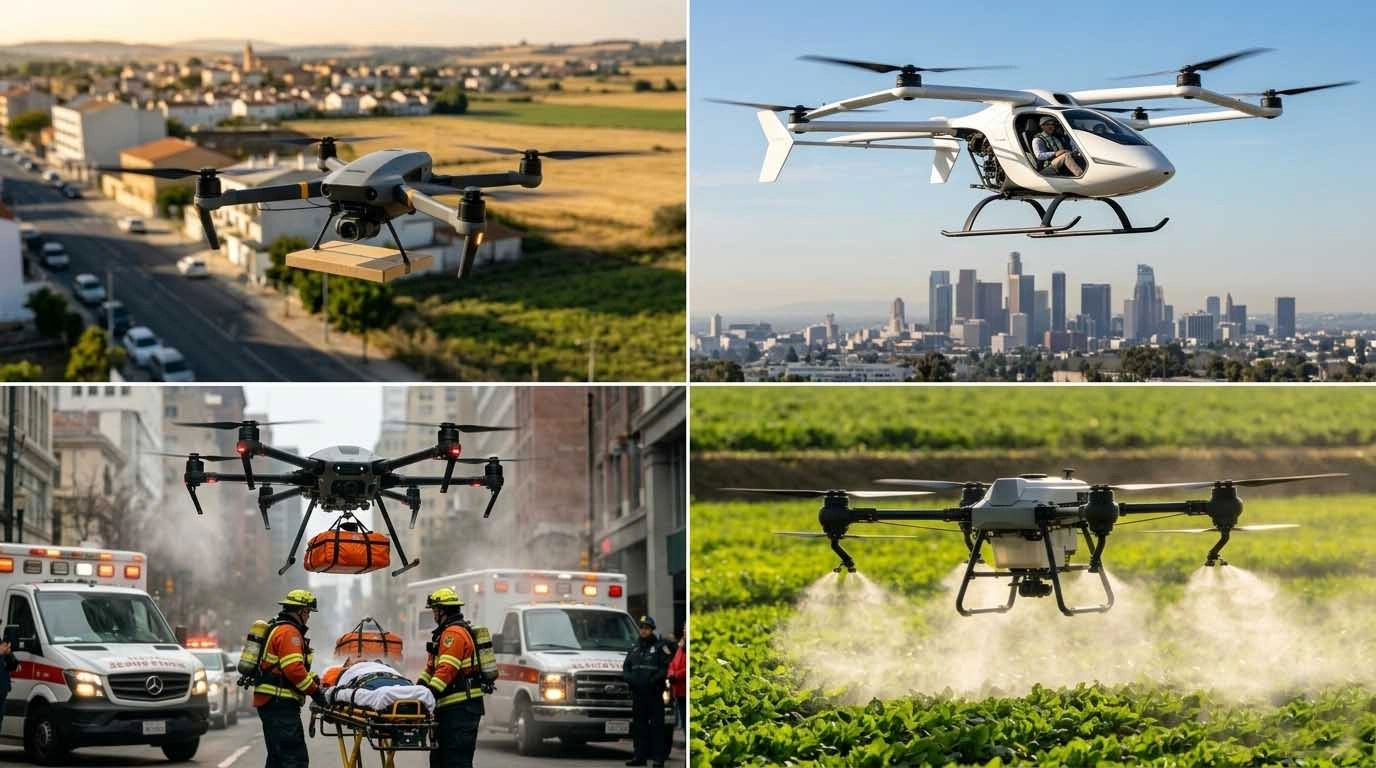
Commercialization: Real-World scenarios in 2026
Currently, several low-altitude applications have entered commercial or semi-commercial operation stages globally:
| Category | Specific Use Case | Key Performance Requirement |
| Logistics | Last-mile delivery, medical supplies, high-end cargo | Payload, range, reliability |
| Agriculture | Precision spraying, seeding, terrain following | High power, corrosion resistance, cycle life |
| Public Safety | Search & Rescue (SAR), fire monitoring, relay | Rapid deployment, environment tolerance, fast charging |
| Inspection | Power line & pipeline monitoring, sensing | Stability, consistency, low-pressure adaptation |
| Entertainment | Drone light shows, sightseeing | Lightweight, fast charging, fail-safe protection |
Technical bottlenecks: the high standards of aviation batteries
The scaling of the low-altitude economy depends heavily on a core component—aviation-grade batteries. Aviation batteries face much stricter standards than EV batteries, primarily dealing with two core challenges:
Range Limitations: Current energy density (Wh/kg) is insufficient for meaningful commercial flight endurance, especially for eVTOL missions.
Safety & Airworthiness: High energy density increases thermal runaway risks; in aviation, there is near-zero tolerance for accidents.
Leading technology routes for aviation batteries (2026)
Global manufacturers and aerospace firms are pursuing technical breakthroughs via three main routes:
| Route | Core Features | Density Target | Key Players |
| High-Nickel Ternary | Mature technology and supply chain | Target 350+ Wh/kg | Vertical, Lilium, Joby Aviation |
| Solid-State / Semi-Solid | Higher density and safety potential | 400-500 Wh/kg | CATL, Saft, Amprius, GS Yuasa |
| Safety & Thermal Mgmt | Prevents runaway propagation | Supports high-energy use | KULR, EaglePicher, Concorde Battery |
Note: Companies like True Blue Power, EnerSys, and Electrovaya primarily focus on battery systems for general aviation and electric fixed-wing aircraft.
Future outlook: airworthiness and value chain
Airworthiness certification (e.g., FAA, EASA) is the core of industry competition in 2026. The certification process typically requires years of rigorous auditing and significant investment. By 2030, the global eVTOL fleet is projected to exceed 100,000 units, driving annual battery demand to 100 GWh.
The complete technology ecosystem also includes:
Flight control systems: Redundancy, fault tolerance, autonomous navigation.
Communication & navigation: Beyond-visual-line-of-sight (BVLOS) links, RTK positioning, anti-interference.
AI & obstacle avoidance: Real-time perception and path planning.
Ground infrastructure: Vertiports and automated charging facilities.
Airspace management: Traffic coordination and safety monitoring.
Powering the skies: NEWARE aviation battery testing solutions
The rise of the low-altitude economy demands unprecedented levels of battery safety and energy density. NEWARE is dedicated to helping aircraft manufacturers overcome technical bottlenecks through high-precision testing technology.
We provide comprehensive testing solutions across the entire value chain—from cells and modules to battery packs:
Advanced R&D: The BTS9000 series features 0.005% accuracy and supports complex pulse testing and DCIR analysis, making it ideal for aviation power material research.
Module & pack validation: The CE-6000 series supports high-power regeneration and rapid dynamic response (≤3ms), perfectly simulating the high-rate discharge requirements of eVTOL during takeoff and landing.
Environmental safety: Integrated high-low temperature explosion-proof chambers ensure performance consistency and airworthiness under extreme flight conditions.
[Explore NEWARE Aviation Battery Testing Solutions] — Making every low-altitude flight safer and more efficient.