Q&A: Quick understanding of data center batteries
Q1: How large is the data center battery market?
Global market: $3.64B in 2025, projected $4.82B in 2026 and $10.23B by 2032 (CAGR 13.4%). Lithium battery segment: $0.96B in 2025, expected $9.15B by 2032 (CAGR 38.5%). China AIDC lithium shipments: ~15 GWh in 2025, may exceed 300 GWh by 2030.
Q2: What battery types are used?
Two main types: VRLA lead‑acid (dominant in legacy UPS – mature, reliable, bulky) and lithium‑ion (compact, longer life, but thermal runaway risks). Lithium penetration hit 7.0% in 2024 (+58.5% YoY). Newer options: sodium‑ion, semi‑solid/solid‑state, and vanadium flow.
Q3: Typical UPS backup duration?
5 minutes to 1 hour, depending on load and redundancy requirements.
Q4: Most critical performance indicators?
High reliability (outages cost millions), long cycle life (some semi‑solid cells reach 12,000 cycles), high power density (short‑duration backup), wide temperature range (-30℃ to 80℃), and millisecond‑level response.
Q5: New demands from AI data centers?
Higher power density and faster response. High‑rate lithium must support 5C short‑duration backup, while BESS enable peak shaving. Some AI centers adopt vanadium flow for GWh‑scale long‑duration storage.
Data center battery market: The "power insurance" of the computing era
The global data center industry is expanding at an unprecedented pace, driven by AI model training and inference, cloud services, and edge computing. Batteries, serving as the "last line of defense" for uninterruptible power, are seeing rapid market growth.
The global data center battery market was $3.64 billion in 2025, projected to reach $4.82 billion in 2026 and $10.23 billion by 2032 (CAGR 13.4%). The lithium battery segment is growing even faster – from $963 million in 2025 to an expected $9.15 billion by 2032 (CAGR 38.5%). In China, AIDC energy storage lithium battery shipments are forecast to exceed 300 GWh by 2030, up from about 15 GWh in 2025.
Key growth drivers include: the rigid demand for high‑power backup in AI data centers, UPS lithium‑ion upgrades in legacy facilities, and the widespread adoption of BESS for peak shaving and grid frequency regulation.
Data center types and battery requirements
Enterprise data centers – serve a single company's IT; typically medium‑sized UPS with 15‑30 min backup, using lead‑acid or small lithium batteries.
Colocation data centers – host multiple tenants; require very high reliability with N+1 or 2N redundant UPS and larger battery banks.
Hyperscale data centers – operated by AWS, Google, Microsoft etc., with power consumption up to tens or hundreds of MW. They require not only large UPS backup but also widespread BESS for peak shaving and grid frequency regulation.
AI data centers (AIDC) – designed for AI training/inference, with extremely high power density, demanding high‑power‑density backup and fast response, driving the adoption of high‑rate lithium batteries and new storage technologies.
Data center battery specifications and performance characteristics
Main battery types
| Battery Type | Features | Typical Voltage | Typical Capacity | Application |
| VRLA lead‑acid | Mature, low cost, high reliability | 12V per cell, series to hundreds of volts | Tens to hundreds of Ah | Legacy UPS backup |
| LFP lithium | High energy density, long cycle life, compact | 384V‑768V | 67‑200 Ah | New data centers, lithium upgrades |
| Semi‑solid/solid‑state | Ultra‑long life, high safety | 512V | 100‑200 Ah | High‑end AIDC |
| Sodium‑ion | Low cost, wide temperature, ultra‑long cycle | 12V‑512V | 100‑200 Ah | Emerging storage |
| Vanadium flow | Long‑duration, intrinsically safe | Custom | GWh‑scale | Ultra‑large storage |
Voltage and capacity parameters
UPS battery systems are typically composed of multiple cells in series to form a high‑voltage DC bus. Examples:
Eaton‑Samsung third‑gen lithium system: 128S (486V, 67Ah/32.6kWh); 136S (517V, 67Ah/34.6kWh)
AIDC high‑voltage lithium system: 192V‑512V, 10kW‑800kW, 10‑60 min backup
Sunwoda high‑voltage system: 512V/140Ah, supports 5C high‑rate short‑duration backup
Core performance characteristics
Ultra‑long design life: typically 10‑15 years; semi‑solid cells can reach 12,000 cycles, over twice that of conventional liquid batteries.
High power density & high‑rate discharge: UPS systems must deliver high power instantly upon grid failure. High‑rate lithium systems support 5C discharge, with some achieving a 100% increase in current‑carrying capacity.
Wide temperature operation: stable from -30°C to 80°C; sodium‑ion supports -40°C to 70°C.
Millisecond‑level power response: BESS must respond within milliseconds to grid fluctuations.
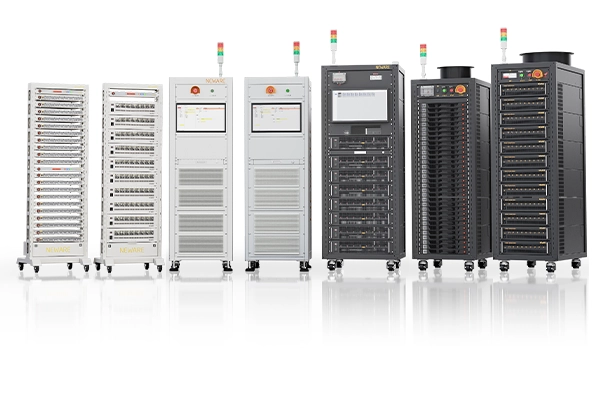
What equipment is needed to test data center batteries?
The high reliability, long life, and high power density requirements impose stringent demands on testing equipment.
BBU backup module testing
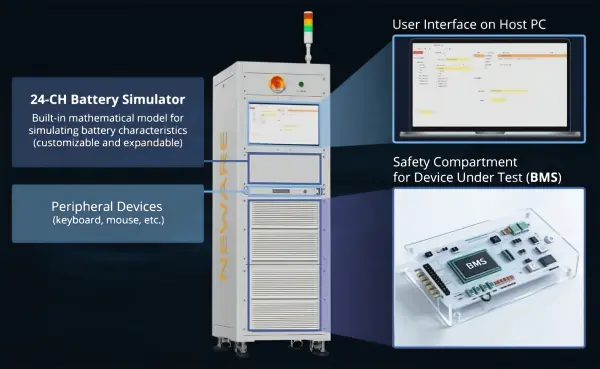
Data center BBUs must take over instantly when mains fails. Testers must support BBU charge/discharge performance, capacity verification (confirming backup duration during outages), and BMS wake‑up simulation with communication monitoring. NEWARE BMS Testing System can simulate BMS wake‑up via test steps and monitor cell conditions through BMS communication.
High‑precision dynamic response & transient load simulation
AI servers have highly transient loads. Testers must provide 5ms fast slope response to accurately simulate AI server load changes, and complete data acquisition and protection decisions in <10ms.
High‑voltage and high‑power testing
Data center battery voltages often reach hundreds of volts (486V‑768V). Testers must cover 600V/800V/1000V ranges. Chen Tech PBT‑2000 supports high‑voltage testing with up to 95% regeneration efficiency.
BMS communication and data validation
Smart batteries are equipped with BMS. Testers must support BMS communication and data binding, recording voltage, current, power, SOC, and BMS information. SOH‑BMS joint validation is critical for long‑term reliability assessment.
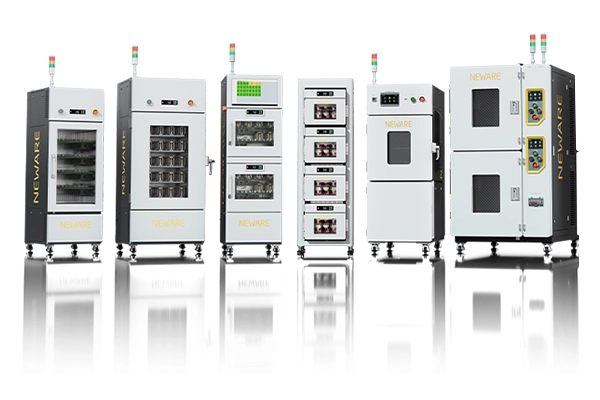
Temperature chamber and aging testing
Testers must integrate environmental chambers for high‑low temperature characterization and long‑term cycle aging testing to track capacity fade and internal resistance growth. Chroma 17010/17010H supports multiple IEC 62620 test conditions.
Compliance with international safety standards
Data center battery testing must comply with: UL 1973 (safety for storage batteries, including fire, nail penetration, etc.), IEC 62620 (performance for industrial lithium batteries), and UN 38.3 (transport safety).
Data center battery testing – the "power gatekeeper" of the computing era
From enterprise server rooms to hyperscale AI data centers, batteries are evolving from "standby last resort" to "intelligent energy dispatch nodes." Lead‑acid remains dominant in legacy systems, while lithium, semi‑solid, sodium‑ion, and flow batteries are rapidly penetrating, driving a comprehensive upgrade of data center energy architecture.
As AI computing demand continues to explode and global data center construction accelerates, precise and reliable battery testing has become the cornerstone that ensures every watt is available "when it counts." From millisecond‑level BBU response verification to 10‑year life tracking of BESS, every testing capability guards the "power lifeline" of the computing era.