Identify redox-active species, determine formal potentials, and characterize new electrode materials with sub-mV precision.
Extract diffusion coefficients, rate constants, and mechanism signatures from scan-rate-dependent voltammograms.
Detect electrode degradation, electrolyte decomposition, and side reactions before they impact battery performance or safety.
A triangular-wave potential is swept linearly between two limits while the resulting current is recorded — producing a voltammogram that maps every electrochemical event.
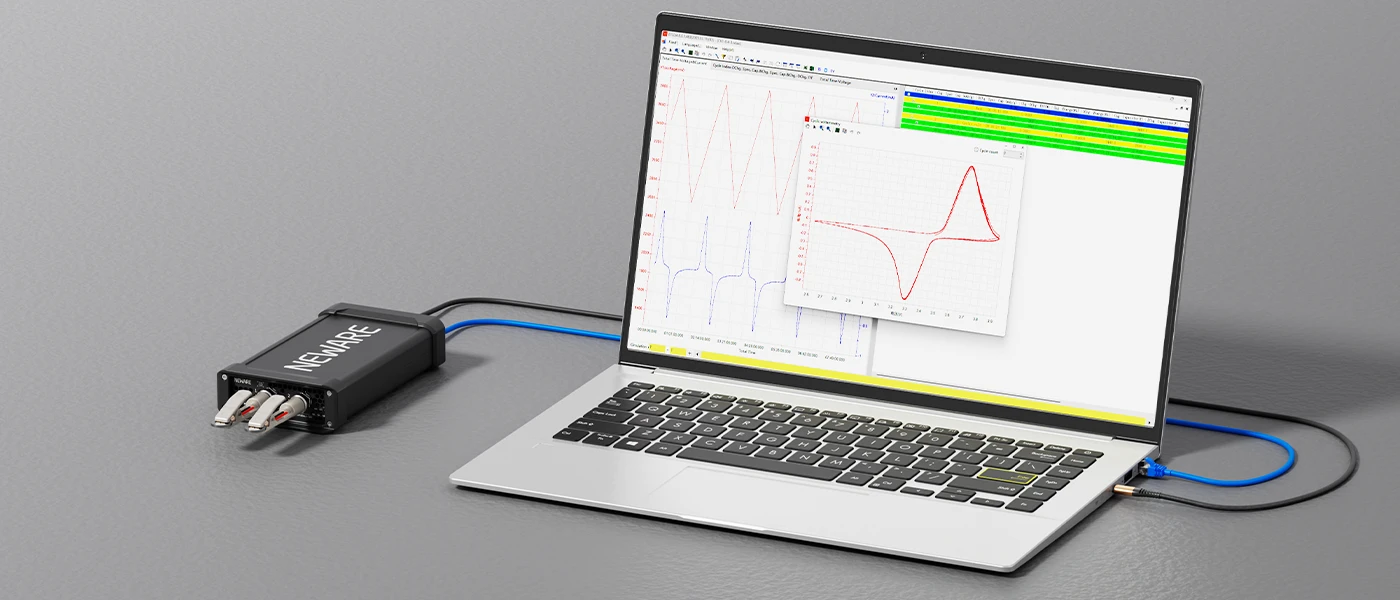
Cyclic Voltammetry (CV) is indispensable across battery R&D, materials science, and electrochemistry.
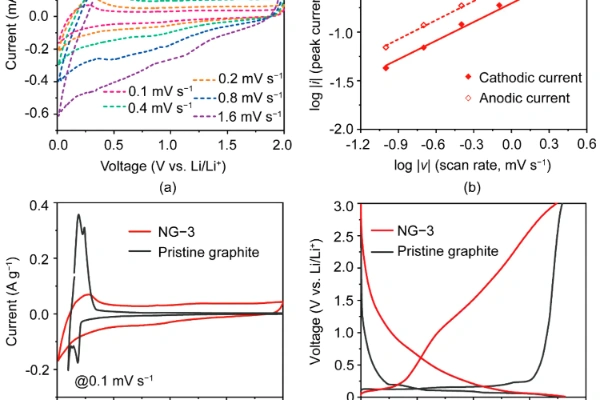
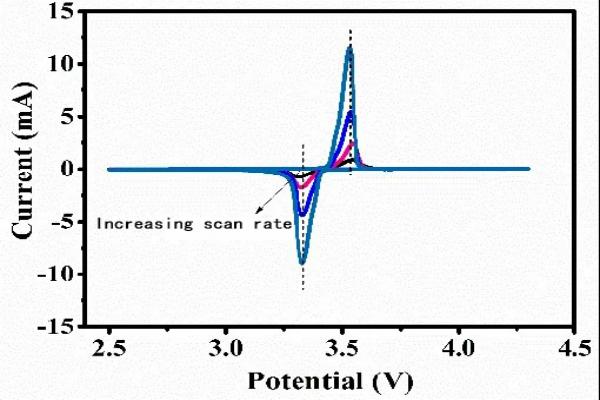
Map lithium insertion/extraction pathways, identify phase transitions, and quantify polarization in Li-ion, Li-S, and solid-state batteries across cycle life.
Evaluate catalyst activity for HER, OER, and ORR. Determine onset potentials, Tafel slopes, and turnover frequencies from voltammetric signatures.
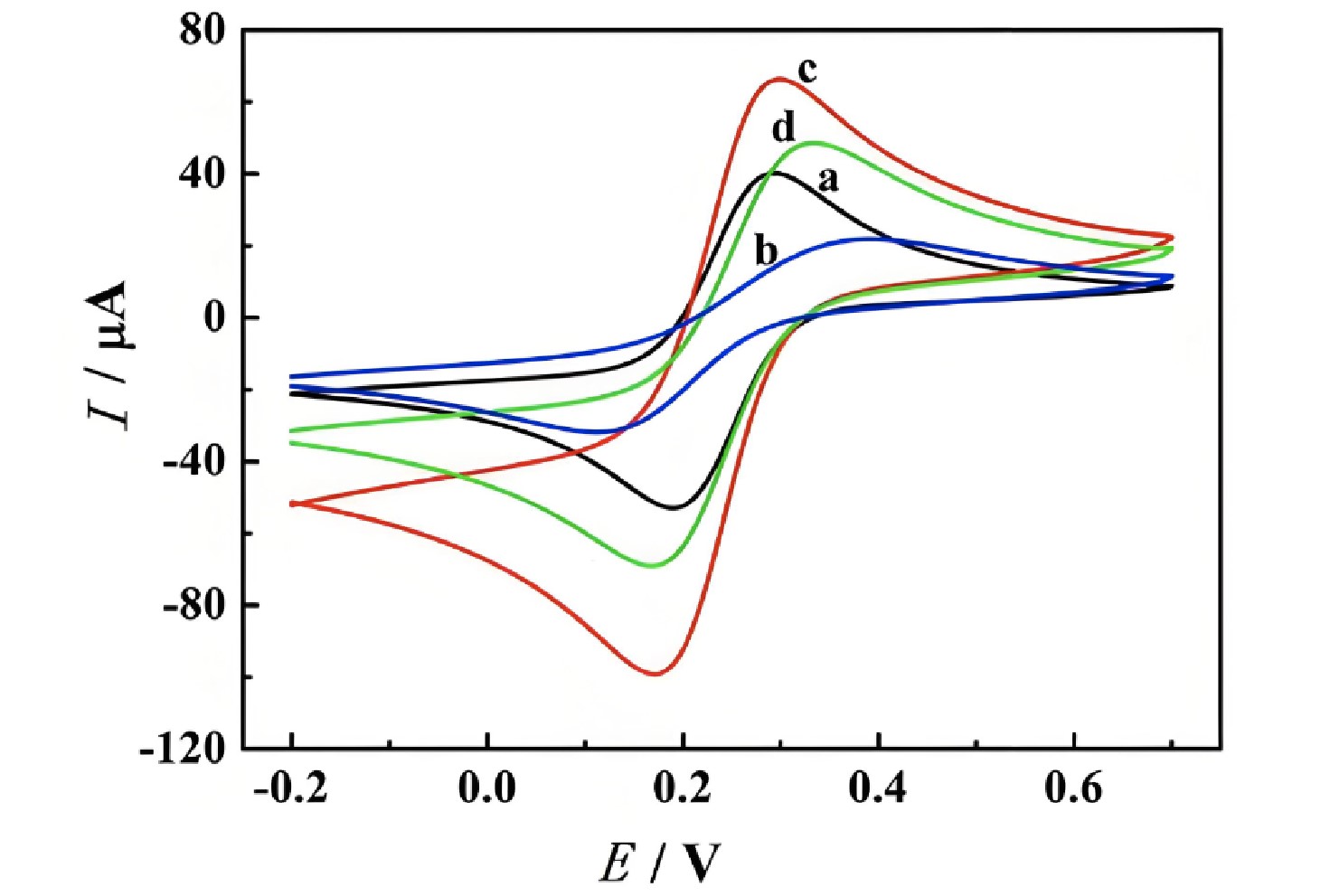
Characterize electrochemical sensors for glucose, DNA, heavy metals, and pharmaceuticals. CV s selectivity, detection limits, and antifouling performance.
Assess corrosion potentials, passivation behavior, and inhibitor effectiveness for metals and coatings in aggressive environments.
Distinguish EC, CE, ECE, and DISP mechanisms through characteristic voltammetric shapes — peak splitting, shifting, and ratio changes with scan rate.
Monitor doping/dedoping transitions, determine electrochemical stability windows, and evaluate cycle stability for PEDOT, polyaniline, and polypyrrole systems.
Early-stage redox events, trace species, and low-concentration analytes produce currents in the sub-microamp range — easily buried by instrument noise, baseline drift, or electromagnetic interference.
Fast kinetics studies demand high scan rates, but instrument response lag and current switching delays distort peak shapes, merge adjacent peaks, and produce artificial hysteresis.
Glove boxes, environmental chambers, and field test sites impose extreme size, weight, and power constraints — most lab instruments cannot fit, and portable devices often sacrifice precision for portability.
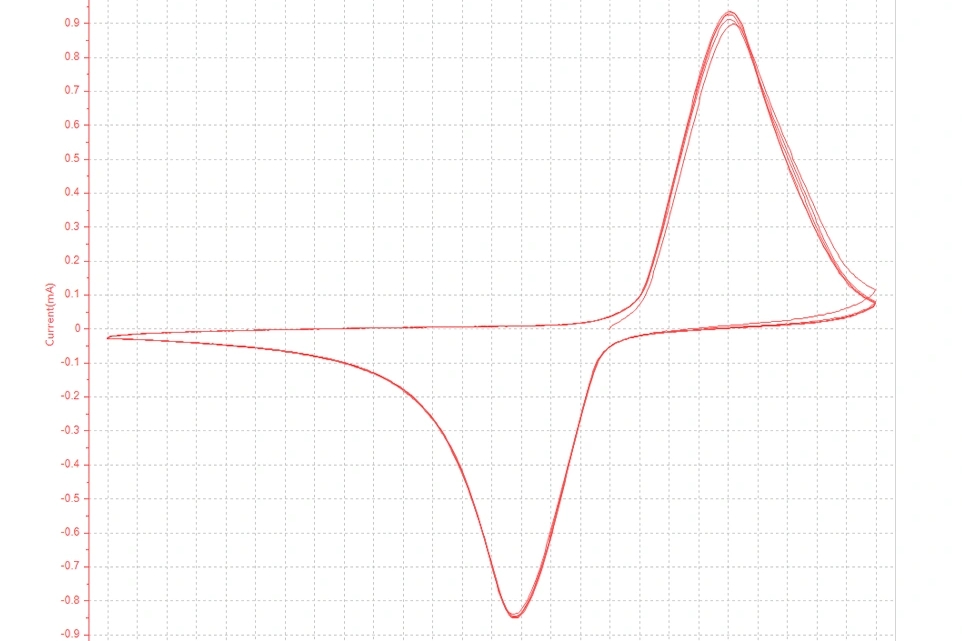
Real battery electrodes involve overlapping redox peaks from multiple phase transitions, side reactions, and degradation products — requiring high-resolution data to separate individual contributions.
Inserting CV scans mid-cycle (to probe electrode state at specific SOCs) demands seamless current switching between galvanostatic and potentiostatic modes without losing synchronization or data continuity.
Purpose-built for demanding CV applications — CT-8002S-5V100mA-CV portable battery testing system addresses each measurement challenge with precision hardware engineering.
Trace redox events and early-stage degradation produce currents below 1μA.
Ultra-fine 24-bit AD conversion with minimum output of 0.2μA and CV cut-off current as low as 0.1μA — capturing faradaic events invisible to conventional instruments.
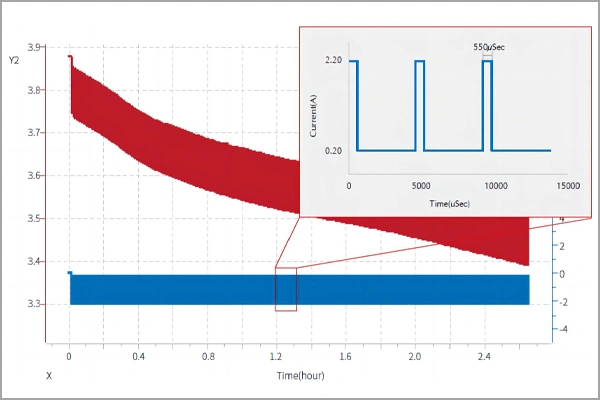
Slow instrument response merges peaks and creates artificial hysteresis loops.
≤20μs current response time with seamless bipolar current switching — no relay delays, no dead time. True waveform reproduction even during fast transients.
Removing cells from test environments to measure CV introduces artifacts and breaks experimental continuity.
Smaller than a textbook. Fits inside glove boxes and environmental chambers. Type-C power with offline testing and power-failure protection — true in-situ CV without compromise.
Battery electrodes show overlapping peaks from phase transitions, side reactions, and degradation products.
0.1mA to 100mA across 6 auto-switching ranges — each range maximizes resolution for its current window. Overlapping peaks resolve cleanly when each current regime is measured at full precision.
Switching between galvanostatic cycling and potentiostatic CV scans introduces gaps, drift, and data discontinuity.
Set the cycle number and the system automatically inserts CV scans — switching between CC/CV and potentiostatic modes without breaking the data stream. Probe electrode state at any SOC.
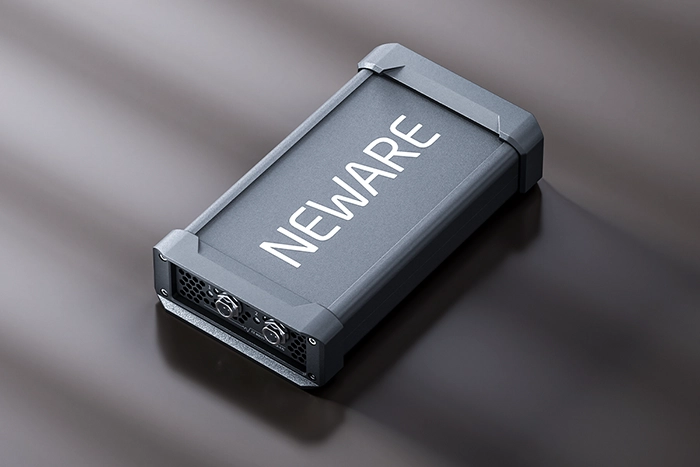
Portable battery testing system with deep CV capability. 226 × 127 × 48(mm) — fits inside glove boxes, environmental chambers, and carries to any field test site.
| Voltage Range | -5V to 5V |
|---|---|
| Voltage Accuracy | ±0.01% F.S. |
| Current Ranges | 0.1mA / 1mA / 5mA / 10mA / 50mA / 100mA |
| Current Accuracy | ±0.01% F.S. |
| Minimum Output Current | 0.2μA |
| CV Cut-off Current | 0.1μA / 1μA / 5μA / 10μA / 50μA / 0.1mA (by range) |
| AD / DA Resolution | 24-bit / 16-bit |
| Current Response | ≤20μs (seamless switching) |
| Channel Output Power | 0.5W |
| CV Function | Insert CV into charge/discharge cycles, multi-scan rate |
| Dimensions | 226 × 127 × 48(mm) |
| Power Interface | USB Type-C, offline testing, power-failure protection |
Our technical experts can help you choose the right CV testing configuration for your application.