I. Introduction: confronting interfacial challenges in LMBs with a Nature breakthrough
High-energy-density lithium metal batteries (LMBs) have long suffered from capacity decay and safety hazards induced by lithium dendrite growth and parasitic reactions (such as continuous electrolyte decomposition and hydrogen evolution). Conventional solid-electrolyte interphases (SEIs) are primarily composed of inorganic components (e.g., Li2CO3, LiF, Li2O) and organic byproducts. However, single components struggle to balance high ionic conductivity and superior electronic insulation simultaneously; for instance, conventional LiF exhibits a high Li+ diffusion barrier of 0.73 eV, severely compromising high-rate kinetic performance.
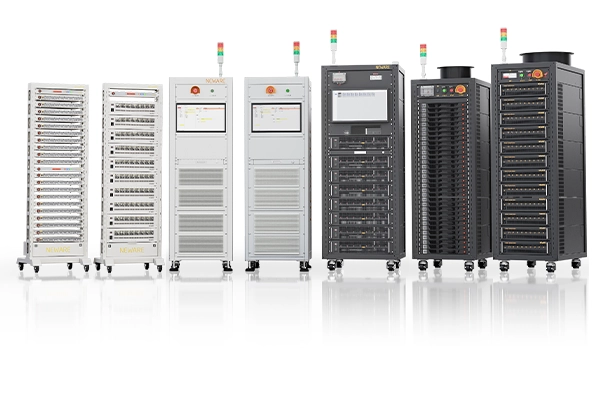
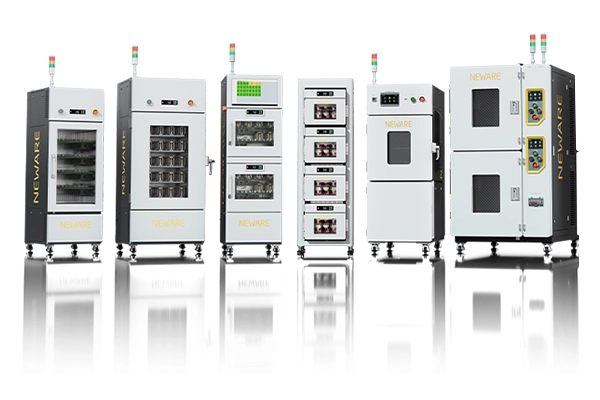
To address this challenge, research teams led by Prof. Keyou Yan (South China University of Technology) and Prof. Xinyong Tao (Zhejiang University of Technology) published a landmark study in Nature titled "Li2ZrF6-based electrolytes for durable lithium metal batteries". The study introduced monoclinic m-Li2ZrF6 nanoparticles as a voltage-driven electrolyte additive, successfully constructing an in situ bilayer solid-electrolyte interphase rich in trigonal t-Li2ZrF6 on the lithium metal surface under electric field driving. Throughout months of rigorous electrochemical characterization, the NEWARE Battery Test System (Model: CT-4008T-5V50mA-164) served as the core testing platform for galvanostatic charge-discharge and long-term full-cell cycling evaluation, providing critical data foundations for validating this innovative material.
II. Theoretical calculations: atomic-level barriers and diffusion kinetics
As the theoretical foundation of this study, the research team first utilized density functional theory (DFT) to deeply analyze the atomic-level behavior of t-Li2ZrF6.
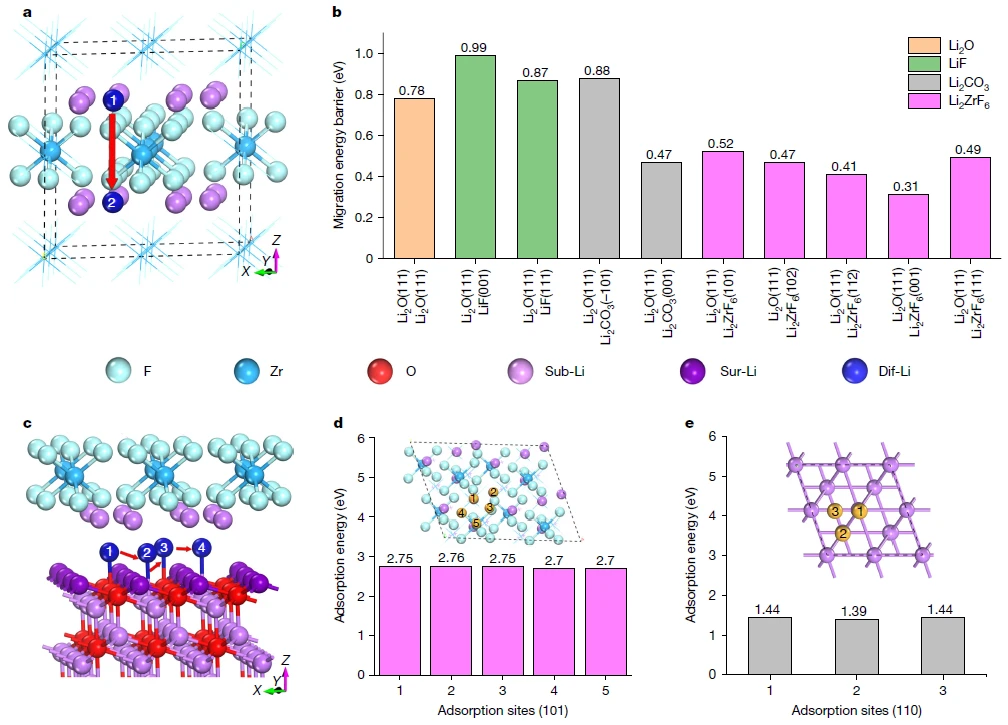
Figure 1: DFT calculations of Li⁺ migration barriers and surface adsorption energies for t-Li₂ZrF₆ (Source: Nature 637, 339–346, 2025).
Ultra-low migration barrier and wide bandgap: Calculation results indicate that the migration barrier of a single lithium ion inside the t -Li2ZrF6 lattice is only 0.22 eV. In more realistic representative grain boundary models (such as the t-Li2ZrF6(001)/Li2O(111) interface), the migration barrier is maintained at only 0.31 eV. Furthermore, its wide bandgap of up to 6.49 eV strongly blocks electron tunnelling, fundamentally preventing detrimental lithium deposition inside the SEI.
Lithiophilic sites and uniform nucleation: Surface adsorption energy calculations in Figs. 1d and 1e confirm that the t-Li2ZrF6 surface possesses abundant and stable lithiophilic sites, guiding lithium atoms to deposit uniformly on the SEI surface upon gaining electrons rather than forming dendrites.
III.Microstructural characterization: cryo-HRTEM verification of the bilayer SEI
To intuitively verify theoretical predictions, the research team utilized cutting-edge characterization techniques to conduct nanoscale stereoscopic dissection of the anode surface.
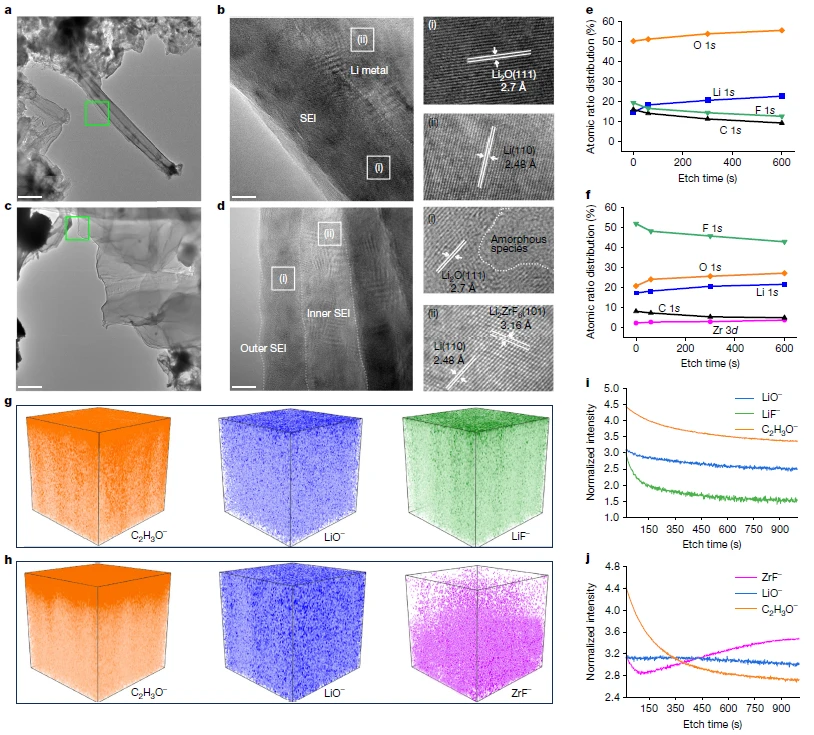
Figure 2: Cryo-HRTEM and TOF-SIMS characterization of the bilayer SEI structure on Li anodes (Source: Nature 637, 339–346, 2025).
Limitations of the standard control group (E-STD): In conventional carbonate electrolytes, lithium deposition manifested as loose dendrites, with a disordered mosaic SEI on its surface embedded with poorly passivating Li2O crystals and intertwined organic byproducts
Bilayer configuration of the optimized group (E-Li2ZrF6-N): Upon introducing the additive, cryogenic transmission electron microscopy (Cryo-HRTEM) clearly captured a distinct bilayer SEI structure : an outer layer composed of amorphous organics and Li2O, and an inner layer dominated by highly crystalline t -Li2ZrF6 crystals (with (101) lattice spacing of 3.16 Å). Time-of-flight secondary ion mass spectrometry (TOF-SIMS) 3D depth profiling perfectly corroborated this spatial distribution, proving the ultra-high stability of this structure during operation.
IV. Full-cell validation: 3,000 ultra-long cycles and impedance evolution
Under rigorous full-cell operating conditions close to practical industrial standards (Li-C/LFP system, LFP loading of 1.8 mAh/cm², N/P ratio of only 5.5), the research team evaluated long-term performance at high 1C/2C rates.
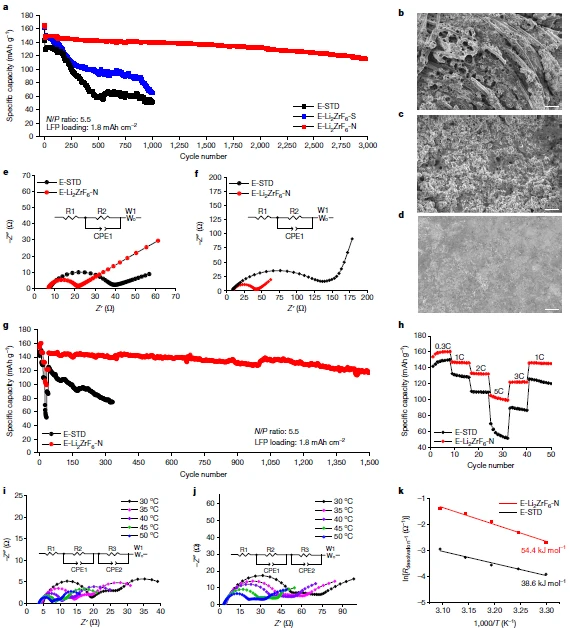
Figure 3: 3,000-cycle performance (tested via NEWARE) and interfacial impedance evolution of Li-C/LFP full cells (Source: Nature 637, 339–346, 2025).
During this testing cycle lasting several months, the NEWARE Battery Test System (CT-4008T-5V50mA-164) demonstrated irreplaceable hardware value:
High-fidelity recording of 3,000 ultra-long cycles: As shown in Fig. 3a of the original paper, full cells utilizing the optimized electrolyte achieved an astounding 80.1% capacity retention after 3,000 cycles at high 1C rates, whereas the traditional control group failed within 150 cycles. NEWARE equipment ensured absolute high-fidelity recording of capacity evolution and Coulombic efficiency (CE) curves over thousands of cycles, thanks to its outstanding long-term hardware stability and current thermal drift control.
Minimal impedance growth and variable-temperature kinetics: After 1,000 cycles, the interfacial resistance (EIS) of the optimized group increased by only ~20 Ω, vastly outperforming the control group which surged to 135 Ω. Combined with variable-temperature EIS tests and Arrhenius fittings , the high-resolution sampling provided by NEWARE equipment offered a solid data foundation for researchers to precisely calculate desolvation activation energy.
V. Mechanism deep dive: voltage-driven ion release and dynamic self-healing
To thoroughly reveal the brilliance of the m-Li₂ZrF₆ additive, the research team conducted a series of mechanistic explorations.
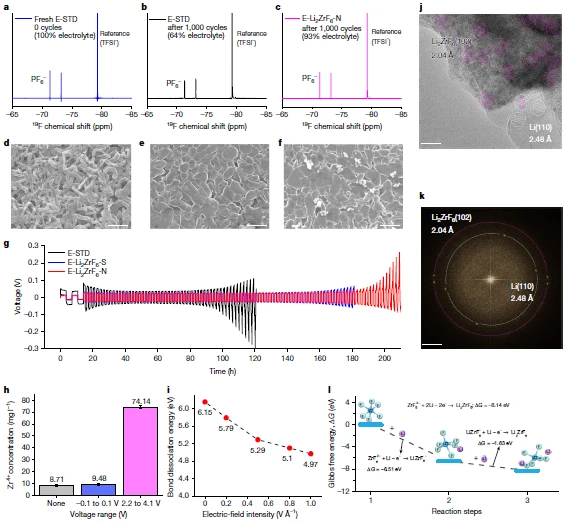
Figure 4: Voltage-driven Zr⁴⁺ release mechanism of m-Li₂ZrF₆ and symmetric cell overpotential profiles (Source: Nature 637, 339–346, 2025).
High-voltage-driven Zr⁴⁺ release mechanism: Inductively coupled plasma mass spectrometry (ICP-MS) analysis revealed a crucial phenomenon: when cycling within a low voltage window of -0.1 V to 0.1 V, the concentration of free Zr⁴⁺ in the electrolyte remained nearly unchanged; however, after 20 cycles within the normal full-cell operating voltage range of 2.2 V to 4.1 V, the Zr⁴⁺ concentration surged to 74.14 mg/L. This proved that higher operating voltages can continuously drive the additive to release active functional groups, achieving dynamic self-healing of damaged SEI.
Minimal overpotential performance in symmetric cells: In galvanostatic plating/stripping tests, the polarization overpotential of the optimized symmetric cell was stably suppressed to around 20 mV. Leveraging micro-ampere current control sensitivity and millivolt-level voltage sampling precision, NEWARE equipment perfectly captured this subtle polarization overpotential fluctuation, ensuring the accuracy of electrochemical kinetic analysis.
VI. Conclusion
The lithium metal battery interphase breakthrough published by the South China University of Technology and Zhejiang University of Technology teams in Nature paves a clear pathway toward the commercialization of high-energy-density storage devices. From atomic-level theoretical calculations (Fig. 1) to cryogenic electron microscopy structural analyses (Fig. 2), and multi-month validations spanning 3,000 ultra-long full-cell cycles (Fig. 3, Fig. 4), every breakthrough conclusion relies fundamentally on uncompromising, high-precision electrochemical testing hardware. NEWARE is deeply honored to empower top-tier global research teams with stable, high-precision testing solutions, and remains committed to advancing next-generation battery R&D and industrialization through precision instruments.

Citation: Xu, Q., Li, T., Ju, Z. et al. Li₂ZrF₆-based electrolytes for durable lithium metal batteries. Nature 637, 339–346 (2025).https://doi.org/10.1038/s41586-024-08294-z