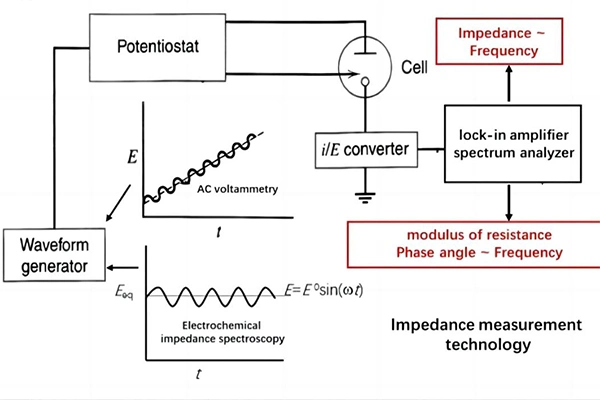
Probe internal electrochemical processes without disassembling the cell — monitor degradation mechanisms in real time throughout battery lifetime.
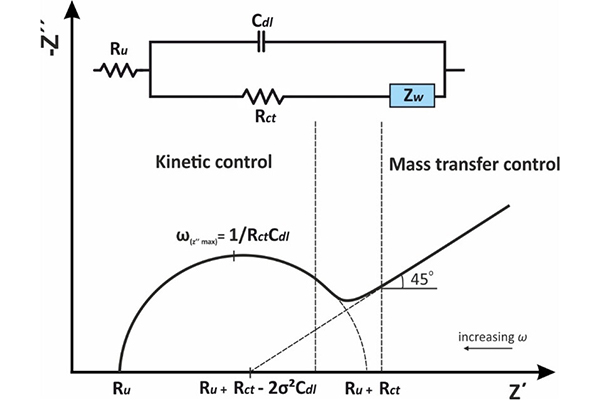
Separate overlapping processes by their characteristic time constants — bulk resistance, SEI, charge transfer, and diffusion each occupy distinct frequency windows.
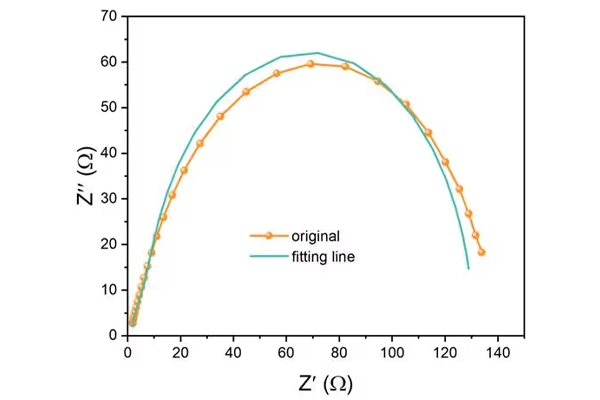
Extract physical parameters — RCT, CDL, Warburg coefficients — enabling predictive SOC/SOH estimation and equivalent circuit modeling.
From battery SOH estimation and SEI characterization to fuel cell diagnostics and corrosion monitoring, EIS provides a complete impedance fingerprint — separating bulk resistance, charge transfer, and diffusion in a single, non-invasive measurement.
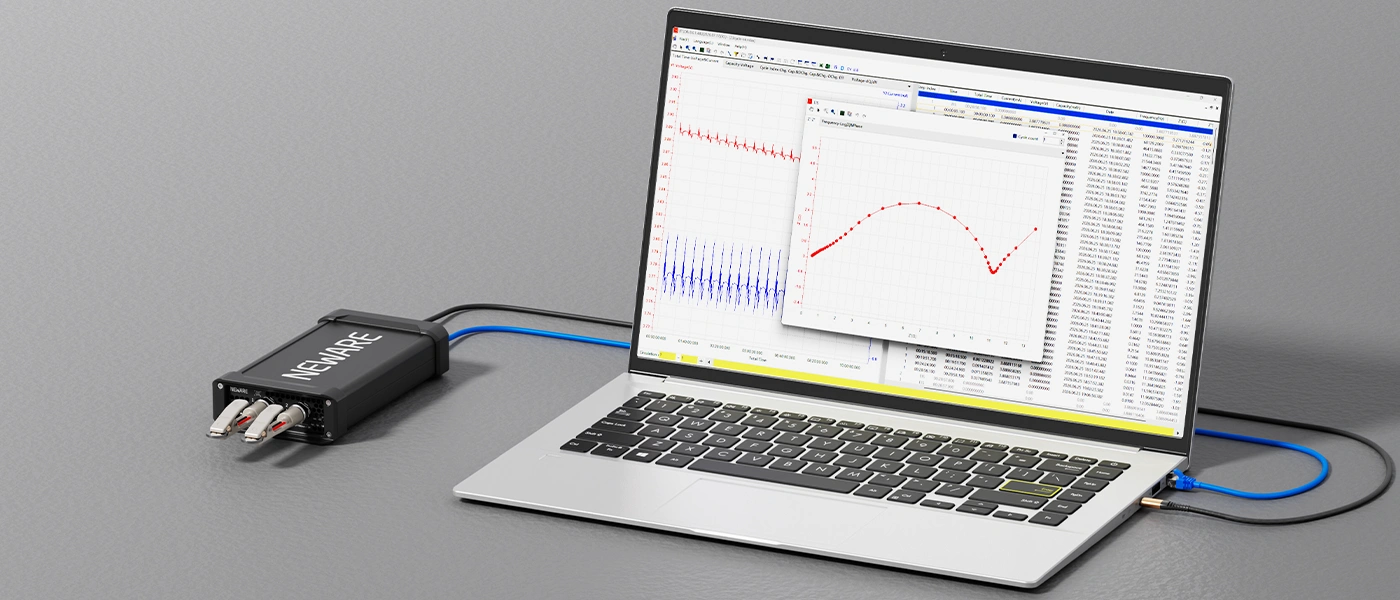
EIS is the gold standard for non-destructive electrochemical characterization.
Track RCT growth and SEI thickening across cycle life. EIS-derived parameters correlate directly with capacity fade, enabling predictive remaining useful life models.
Distinguish SEI growth from lithium plating by their distinct time constants. Early detection of Li plating is critical for safety — EIS provides non-invasive monitoring without cell disassembly.
Separate activation, ohmic, and concentration overpotentials in fuel cells. Diagnose membrane drying, flooding, and catalyst degradation from impedance spectra.
Measure coating degradation, pitting initiation, and inhibitor effectiveness. EIS detects corrosion before visual inspection — critical for infrastructure and marine applications.
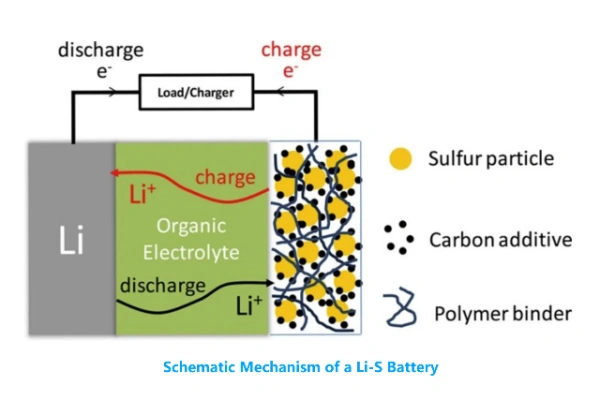
In-situ EIS captures polysulfide shuttle dynamics in lithium-sulfur batteries. The low-frequency impedance evolution s dissolution, migration, and re-deposition of active sulfur species.
Characterize biosensor and chemical sensor interfaces. EIS s charge transfer resistance changes upon analyte binding — enabling label-free detection with quantitative sensitivity.
Parasitic capacitance, cable inductance, and limited instrument bandwidth distort impedance at high frequencies (>1 kHz), corrupting bulk resistance and contact measurements that define the foundation of the equivalent circuit.
Superimposing EIS perturbation on active charge-discharge requires extraordinary signal isolation. DC current ripple, relay switching transients, and mode transitions all contaminate the AC impedance signal.
Small perturbation amplitudes (needed for linearity) produce tiny response signals — especially at frequency extremes. Electromagnetic interference, ground loops, and ADC quantization noise degrade measurement quality.
Cable resistance, connector contact impedance, and thermal EMFs introduce systematic errors. Two-wire measurements conflate cell impedance with lead resistance — fatal for low-impedance cells below 10 mΩ.
Purpose-built for demanding EIS applications — the CT-8002S-5V100mA-EIS integrates dual-channel impedance spectroscopy directly into a precision battery testing platform, eliminating the need for external frequency response analyzers.
Parasitic effects and slow instrument response distort impedance above 1kHz.
Bipolar linear circuits — no relay switching between charge and discharge. Current crosses zero smoothly with μs-level response, preserving high-frequency signal integrity without artifacts.
DC ripple and mode switching transients corrupt the AC impedance measurement.
EIS is natively integrated with charge-discharge — no external FRA needed. Impedance spectra acquired in-situ during cycling with full signal isolation from DC current paths.
Small perturbation amplitudes produce response signals vulnerable to EMI and quantization noise.
24-bit AD and 16-bit DA resolution with ±0.01% F.S. accuracy across all ranges. 1ms (1000Hz) sampling captures the full impedance response with exceptional dynamic range and minimal quantization noise.
Two-wire measurements conflate lead resistance with cell impedance — fatal for low-impedance cells.
Four-wire Kelvin connections bypass all cable and contact resistance. Voltage is sensed directly at the electrode terminals — achieving micro-ohm impedance resolution even for cells below 10mΩ.
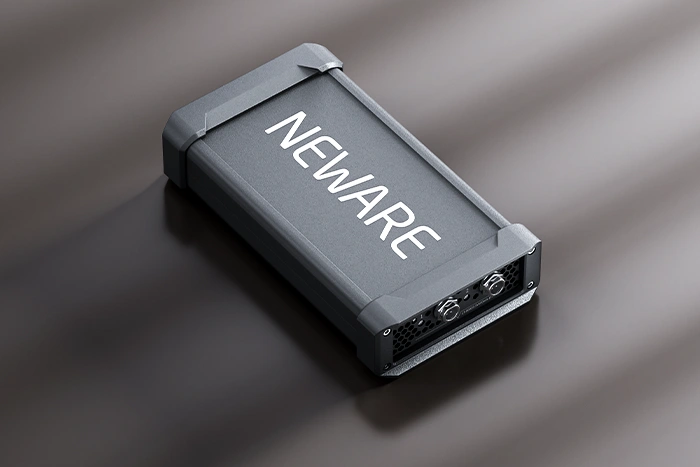
Ultra-high-precision portable battery testing system with built-in EIS on every channel. Dual-channel simultaneous impedance measurement — seamlessly fused with charge-discharge and CV processes.
| Voltage Range | -5V to 5V |
|---|---|
| Voltage Accuracy | ±0.01% F.S. |
| Current Ranges | 0.1mA / 1mA / 5mA / 10mA / 50mA / 100mA |
| Current Accuracy | ±0.01% F.S. |
| AD / DA Resolution | 24-bit / 16-bit |
| Sampling Interval | 1ms (1000Hz) |
| Current Response | Microsecond-level (bipolar linear, no relay) |
| Channel Output Power | 0.5W |
| EIS Channels | Dual-channel simultaneous EIS (standard on every channel) |
| CV Function | Multi-scan rate CV, dual-channel simultaneous |
Our technical experts can help you choose the right EIS testing configuration for your application.