1. What is High Power Pulse Characterization (HPPC) testing?
1.1 Definition of HPPC testing
High Power Pulse Characterization (HPPC) testing is a standard test method for evaluating battery performance by applying a high power pulse current to the battery to simulate the operating conditions of the battery in actual use. This test method effectively evaluates a battery's power characteristics, energy density, internal resistance, and its dynamic performance, and is widely used in electric vehicles, grid energy storage, and consumer electronics.
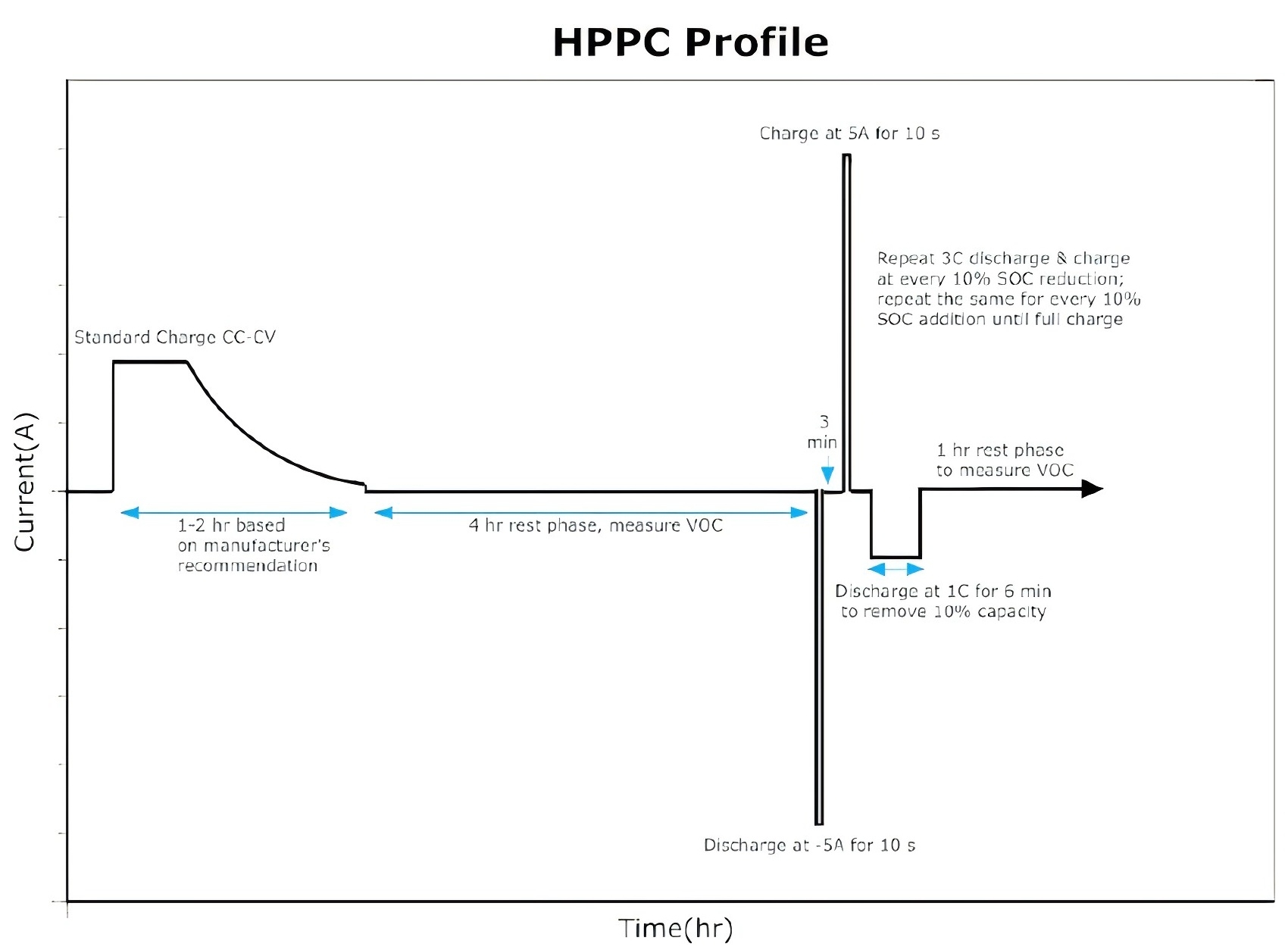
Figure1 HPPC test profile
1.2 Historical background of the HPPC test
HPPC testing originated as an in-depth study of battery performance in electric vehicles, aiming to simulate the demands placed on batteries by vehicles under different driving conditions. With the widespread popularity of electric vehicles and energy storage systems, HPPC testing has become an important part of battery R&D and quality control, helping developers and manufacturers optimize battery design and improve product performance.
2. Basic principles of HPPC testing
2.1 Relationship between high power pulses and battery performance
In real-world applications, batteries are often required to cope with transient high power demands, such as acceleration and braking in electric vehicles, where internal resistance, power output and energy recovery become critical. In these situations, the battery's internal resistance, power output capability and energy recovery become critical, and the HPPC test simulates these real-world scenarios by applying a series of high-power pulses to evaluate the actual battery performance.
2.2 Key parameters for HPPC testing
HPPC testing centers on measuring the battery's voltage response and internal resistance changes under high power pulses. The main parameters of interest include:
DC Internal Resistance (DCIR): Indicates the voltage drop of the battery under high power conditions, reflecting the efficiency and heat generation of the battery.
Pulse power capability: the maximum power output that the battery can provide in a specified time period.
Energy density: the amount of energy a battery can store per unit of volume or weight, which directly affects the battery's range.
3. The role of HPPC testing in battery performance evaluation
3.1 Internal resistance measurement
Internal resistance measurements in HPPC testing are an important metric for evaluating battery efficiency. Lower internal resistance means higher efficiency and less heat loss, which is especially critical for long-term operation of electric vehicles and energy storage devices.
3.2 Power and energy density assessment
The HPPC test can accurately measure the power output and energy density of the battery in different states, helping R&D staff to optimize the battery design and enhance the market competitiveness of their products.
3.3 Battery life prediction
The HPPC test simulates the performance of a battery under different usage conditions, and then predicts its life and degradation trends, providing users with reliable battery life data.
4. Characteristics of NEWARE's charge/discharge test equipment
4.1 Technical advantages of NEWARE equipment
NEWARE's charge/discharge test equipment excels in HPPC testing with high accuracy and stability. Its advanced current control technology and efficient data acquisition system can provide accurate test data in a very short period of time, providing strong support for R&D and production.
4.2 Automation and data accuracy
NEWARE equipment supports full automation testing, users only need to set the initial parameters to complete the entire testing process, greatly improving the testing efficiency. Meanwhile, its high-precision data acquisition system ensures the accuracy of the test results, providing a reliable basis for subsequent analysis.
5. International standards for HPPC testing
5.1 ISO 12405
The ISO 12405 standard focuses on the performance testing of lithium-ion battery systems for electric vehicles and covers the specific requirements for HPPC testing. The standard specifies in detail the test conditions, methods and data processing to ensure the comparability of test results worldwide.
5.2 IEC 62660 series of standards
The IEC 62660 series of standards also applies to EV batteries, with a particular focus on safety and performance assessment of batteries.HPPC testing is used as a key assessment tool in these standards to verify the performance of batteries under high power demands.
5.3 SAE J1798 standard
The SAE J1798 standard is primarily used to describe the application of batteries in hybrid vehicles. The standard describes in detail the execution steps of the HPPC test to ensure that the test results can truly reflect the performance of the battery in vehicle operation.
6. Specific interpretation of HPPC tests by international standards
6.1 ISO 12405 requirements for batteries for electric vehicles
The ISO 12405 standard emphasizes the importance of HPPC testing in the performance evaluation of EV batteries, requiring that the tests be conducted within a certain temperature range to ensure the accuracy and repeatability of the results.
6.2 IEC 62660 specification for battery safety and performance
The IEC 62660 standard focuses more on the safety and performance of batteries under extreme conditions. the HPPC test is used to assess whether a battery can withstand high power loads for a short period of time without overheating or failure.
6.3 Application scenarios under the SAE standard
The SAE J1798 standard describes in detail practical application scenarios for HPPC testing, particularly in hybrid and pure electric vehicles, and highlights how the test results can help optimize the vehicle's powertrain and energy management strategies.
7. How to perform the HPPC test
7.1 Test preparation
Before performing HPPC testing, it is necessary to ensure that the battery is in a proper state of charge and that the test equipment is calibrated to provide a stable current and voltage output.
7.2 Testing steps in detail
Preheating and stabilization: preheat the battery to standard temperature and stabilize it for a period of time.
Pulse application: apply high power pulses according to standard requirements and record the voltage and current response of the battery.
Data acquisition: record the battery performance data during the test through a high-precision acquisition system.
7.3 Data acquisition and analysis
The collected data are processed using data analysis software to generate key indicators such as internal resistance and power output, and compared with standard requirements.
8. Application scenarios for HPPC testing
8.1 Electric vehicle battery testing
Widely used in the development and quality control of electric vehicle batteries, HPPC testing evaluates the dynamic performance and durability of batteries by simulating the power demand under real driving conditions.
8.2 Assessment of energy storage systems
In energy storage systems, HPPC testing helps to evaluate the performance of batteries during rapid charging and discharging to ensure stable system operation under high load conditions.
8.3 Battery performance analysis for consumer electronics products
The HPPC test is also applicable to the battery performance evaluation of consumer electronics products such as smartphones and laptops, helping to improve the user experience and endurance of the products.
9. Challenges and solutions in HPPC testing
9.1 Temperature control
Temperature variations have a significant impact on battery performance. Data errors caused by temperature fluctuations during testing can be effectively minimized by precise temperature control equipment.
9.2 Effects of battery decay
Battery degradation due to long-term use may affect HPPC test results. Regular battery State of Health (SOH) assessments, combined with HPPC test data, can provide a more accurate prediction of battery life.
9.3 Improvements in data accuracy
High-precision data acquisition equipment and advanced algorithmic analysis can effectively improve the data accuracy of HPPC testing and ensure the reliability and repeatability of the results.
10. The role of HPPC testing in R&D and production
10.1 Application in battery development
During the battery development phase, HPPC testing helps researchers understand the impact of different materials and designs on battery performance, providing critical data to support optimization of battery performance.
10.2 Importance in production quality control
During the manufacturing process, HPPC testing can be used for quality control to ensure that the performance of the cells leaving the factory meets design standards and customer requirements.
11. Frequently asked questions (FAQ) for users
Q: Time cycle for HPPC testing
A: The time period for HPPC testing varies depending on the type of battery and the test criteria, and typically takes anywhere from a few hours to a few days.
Q: How do I ensure the accuracy of my test data?
A: Data accuracy can be effectively ensured through regular calibration of equipment, precise control of test conditions, and the use of highly accurate data acquisition systems.
Q: What are the unique advantages of NEWARE equipment?
A: NEWARE equipment is ideal for HPPC testing due to its high accuracy, stability, automation and user-friendly interface.
Q: How does the HPPC test differ from other battery tests?
A: The HPPC test focuses on evaluating battery performance under high power conditions, while other tests such as the capacity test focus more on the battery's energy storage capacity.
Q: How to interpret HPPC test results in applications?
A: HPPC test results can be used to evaluate battery internal resistance, power output capability and life prediction to help optimize battery design and system configuration.
Q: HPPC test equipment selection guide
A: When selecting HPPC test equipment, its technical performance, vendor services, equipment stability and cost-effective factors should be considered to ensure that it meets the experimental needs and budget requirements.